
- All
- Product Name
- Product Keyword
- Product Model
- Product Summary
- Product Description
- Multi Field Search
In heavy-duty mining, bucket lip wear can lead to costly repairs, unplanned downtime, and reduced equipment availability. Choosing the right bucket lip protection system is essential for maintaining productivity and controlling long-term operating costs.
Two common solutions are J-Bolt centre lip shrouds and weld-on lip shrouds. Both protect exposed bucket lips from abrasive materials, but they differ significantly in attachment methods, replacement procedures, maintenance requirements, and material design.
Which is better for mining? J-Bolt lip shrouds are generally preferable for high-wear applications requiring frequent replacement and reduced welding during maintenance. Weld-on lip shrouds can be a practical alternative when installation simplicity, initial cost, and existing bucket configurations are the main priorities.
The best choice depends on bucket geometry, operating conditions, replacement frequency, and total lifecycle cost.
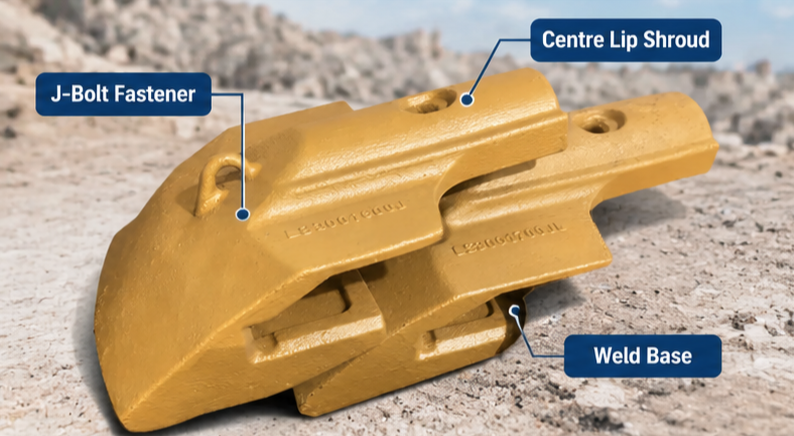
A J-Bolt centre lip shroud is a replaceable Ground Engaging Tools (GET) component designed to protect the central section of a loader or excavator bucket lip from abrasion and impact.
Unlike a conventional weld-on shroud, the J-Bolt design uses a mechanical fastening arrangement to secure the replaceable wear component to the bucket.
A typical system includes:
Lip shroud: The sacrificial wear component covering the bucket lip.
Weld base: A mounting component initially welded to the bucket structure.
J-Bolt fastener: A mechanical retaining component securing the shroud.
The key advantage is that a worn shroud can be replaced without cutting the entire wear component from the bucket, provided the mounting base remains serviceable.
YASSIAN supplies aftermarket J-Bolt bucket lip shrouds, including the LS3001600J centre shroud and related left-hand and right-hand configurations.

A weld-on lip shroud is a steel wear protector attached directly to the bucket lip through welding.
It creates a protective barrier between the bucket's structural edge and abrasive materials such as rock, gravel, and ore.
Weld-on shrouds are widely used in construction, quarrying, and mining because they offer flexible installation across different bucket designs.
However, replacing a worn weld-on shroud typically involves cutting or removing the existing welds, preparing the bucket surface, and welding a replacement into position.
YASSIAN offers weld-on shroud products for excavator and loader applications, including configurations designed for different bucket lip thicknesses and geometries.

The following comparison highlights the factors that matter most to mining contractors, equipment maintenance teams, and GET distributors.
Comparison factor | J-Bolt lip shroud | Weld-on lip shroud |
Attachment | Mechanical retention with an initially welded base | Directly welded to bucket lip |
Initial installation | Requires compatible base positioning and welding | Requires shroud positioning and welding |
Wear-part replacement | Remove fastener and replace shroud | Cut/remove welds and reweld |
Welding during routine replacement | Usually unnecessary if base remains sound | Usually required |
Material hardness | Can use harder wear-resistant alloys | Must balance hardness with weldability |
Initial system cost | May be higher due to mounting components | Often lower for simple installations |
Maintenance downtime | Potentially lower for repeated replacements | Often longer due to welding work |
Best suited for | Frequent replacement, abrasive mining | General-duty or less frequent replacement |
Actual wear life, cost, and downtime depend on the specific product, operating environment, and installation quality.
Wear resistance is a major consideration when selecting bucket protection components for iron ore, copper, coal, and hard-rock mining.
Mechanically attached shrouds do not require the replaceable wear component itself to be welded to the bucket. This can allow manufacturers to use harder alloy formulations optimized for abrasion resistance.
Hensley, for example, describes its J-Bolt shrouds as having greater hardness than its weld-on alternatives, with applications in mining, quarrying, and other high-wear environments.
Potential advantages include improved resistance to abrasive wear and easier replacement once the component reaches its wear limit.
However, higher hardness alone does not guarantee longer service life. Impact toughness, casting quality, heat treatment, and bucket loading conditions also matter.
Weld-on shrouds must provide adequate wear resistance while remaining suitable for the required welding procedure.
Their performance depends on material selection, shroud thickness, geometry, weld quality, and operating conditions.
For example, Hensley specifies a minimum hardness of 300 Brinell for its weld-on lip shroud range. This is a product-specific reference, not a universal hardness standard for all weld-on shrouds.
Selection insight: For severe abrasion with frequent wear-part replacement, a properly engineered J-Bolt system may offer lifecycle advantages. For moderate wear or existing welded bucket designs, weld-on shrouds may provide sufficient protection at a lower initial investment.
In mining operations, the purchase price of a shroud is only one part of the total cost.
Maintenance labor, equipment availability, welding requirements, and replacement frequency can have a greater impact on operating economics.
A J-Bolt system may reduce downtime during routine wear-part replacement because the shroud can be mechanically removed and replaced without rewelding the complete component.
A weld-on system generally requires more preparation and welding work for each replacement.
As a supplier of aftermarket Ground Engaging Tools, YASSIAN provides bucket wear protection components for construction and mining equipment.
For customers sourcing replacement J-Bolt systems, the following product references are available on the YASSIAN website.
Part number | Product description |
J-Bolt centre lip shroud | |
J-Bolt left-hand lip shroud | |
J-Bolt right-hand lip shroud | |
J-Bolt weld base | |
SFA1J4 | Related J-Bolt fastener reference |
The LS300-series shrouds are associated with selected Hensley-style J-Bolt mounting arrangements. However, part-number matching alone does not establish compatibility, and associated mounting components should not be assumed to be included with the shroud.
Both J-Bolt centre lip shrouds and weld-on lip shrouds play an important role in protecting mining bucket structures.
For operations facing severe abrasion, frequent replacement, and expensive equipment downtime, J-Bolt lip shrouds are often the stronger long-term maintenance choice.
For operations prioritizing straightforward initial installation, established welded configurations, or less frequent replacement, weld-on lip shrouds remain a practical solution.
The most cost-effective option is the one that delivers reliable protection, verified compatibility, and the lowest total operating cost under actual site conditions.
Explore YASSIAN's bucket lip shrouds and wear protection products or contact YASSIAN with your part numbers and technical requirements to discuss suitable replacement components for your mining equipment.


