
- All
- Product Name
- Product Keyword
- Product Model
- Product Summary
- Product Description
- Multi Field Search

Buying a 3G3357 bucket adapter starts with identifying the bucket connection, not simply matching a loader model. Distributors need an accurate replacement reference, while maintenance teams need a part that matches the existing bucket edge, tooth interface and mounting hardware.
This guide explains how to check the reference, distinguish the adapter from the replaceable tooth, compare mounting details and prepare a useful RFQ. Product identification is based on published parts information. The measurement, inspection and purchasing steps are general guidance; final acceptance should follow the documentation for the actual assembly.
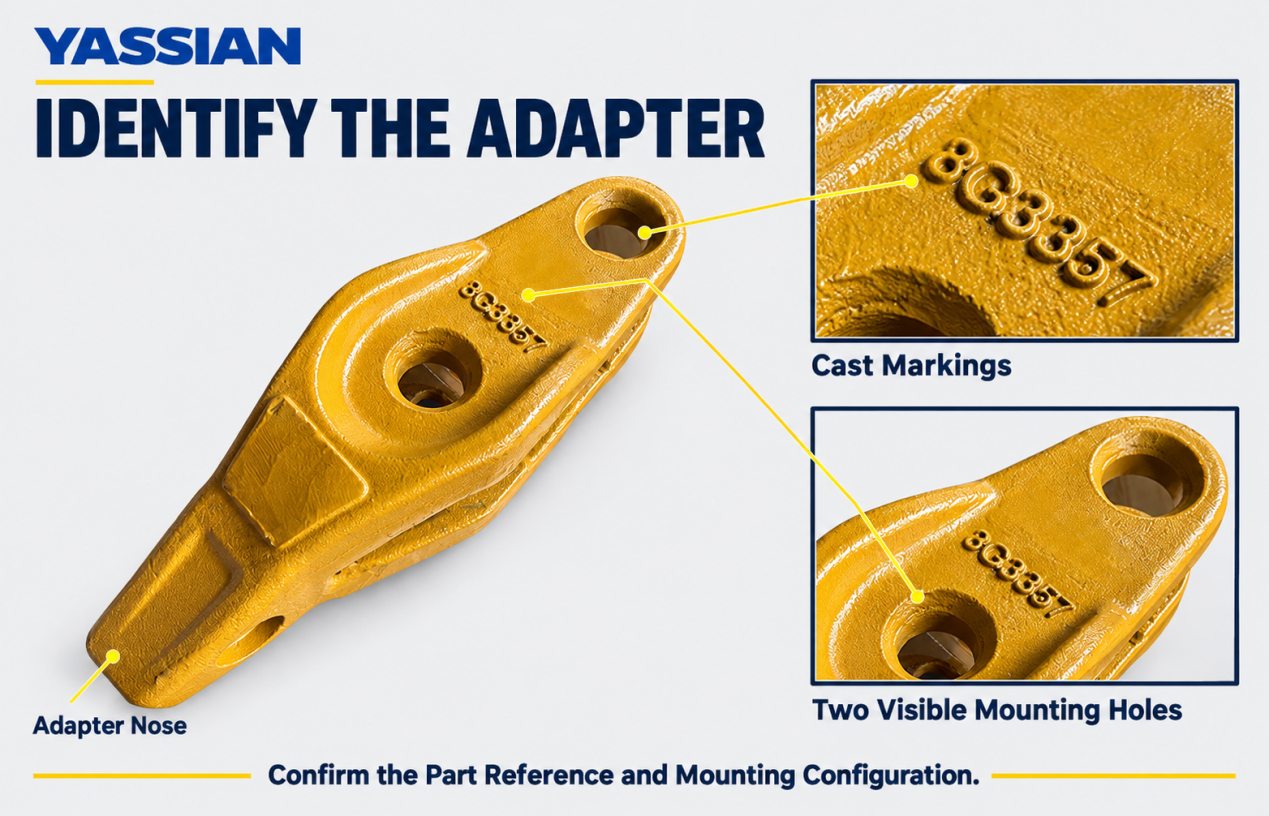
The references 3G3357 and 3G-3357 are two written forms of the same part number. Caterpillar identifies this reference as a J350 center bolt-on two-strap adapter. Costex also lists it within its two-hole bolt-on center adapter category.
An adapter connects the bucket edge to a separate replaceable tooth. It should therefore be distinguished from the tooth itself and from a one-piece bolt-on unitooth. This distinction affects the quotation: an adapter-only price does not necessarily include a tooth or either set of fastening components.
"Center" describes the installation category. It should not be interpreted as a promise that the part replaces left-hand or right-hand corner adapters.
Published Caterpillar and Costex references associate 3G3357 with loader models including 966G, 970F and 972G. These references help narrow the search, but they do not verify every bucket currently fitted to those machines.
A loader may have a replacement bucket, a repaired base edge or a different tooth system from its original configuration. Even a correct machine model can therefore lead to an unsuitable order if the bucket details are missing.
Start with the machine identification and serial number, then record the bucket identification where available. Photograph the complete cutting edge and the adapter being replaced. Include any readable markings without editing them.
For mixed fleets, prepare a separate record for each bucket configuration. Combining all parts under a broad description such as “966 loader adapters” makes it harder to identify differences before shipment.
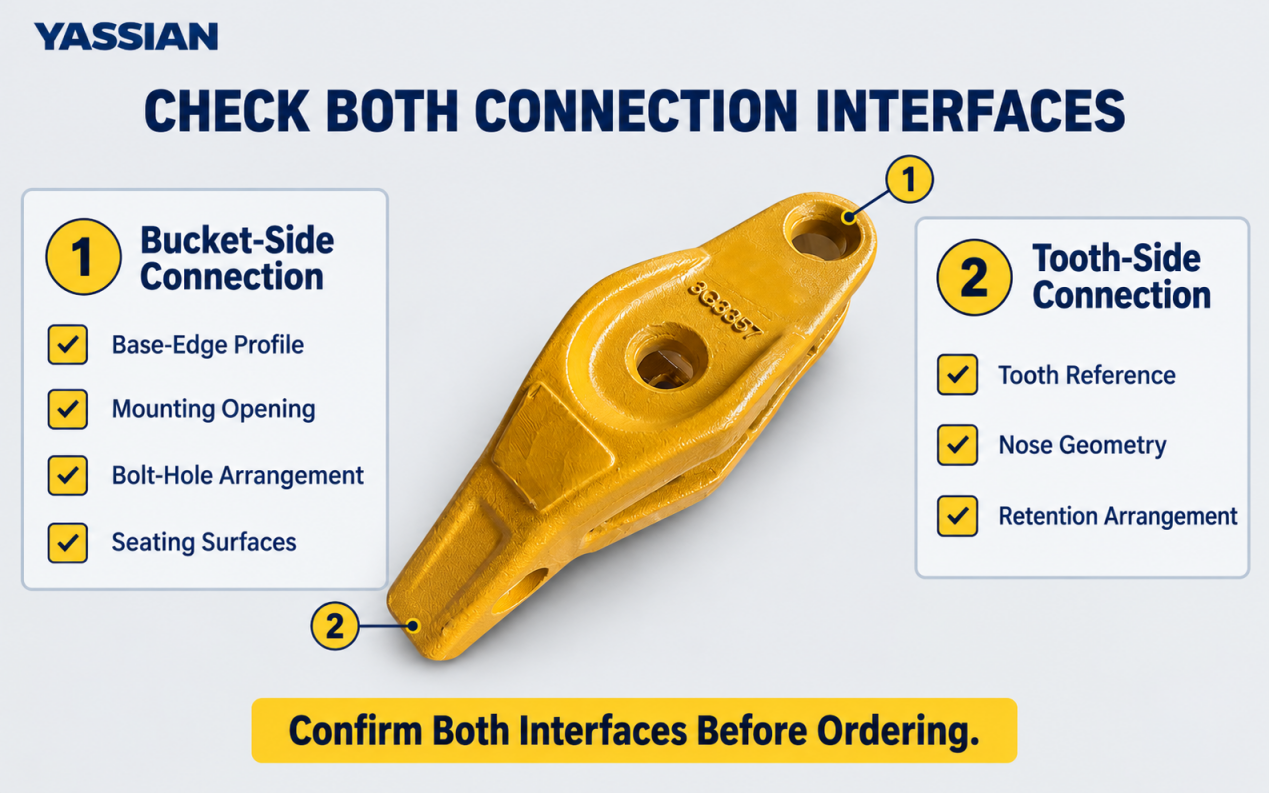
A replacement adapter must match the bucket at one end and the tooth system at the other. Checking only one connection leaves an important part of the fitment question unresolved.
Compare the mounting opening, base-edge profile, bolt-hole arrangement and seating surfaces against an approved drawing or verified sample. Confirm that the mounting position is an interior position requiring a center adapter.
A similar outline does not establish that the mounting faces will seat correctly. Likewise, two visible bolt holes do not prove that their spacing, shape or fastener seats match.
Record the existing tooth reference and provide clear photographs of the adapter nose and retention arrangement. Confirm the proposed tooth, adapter and retaining components together.
The J350 designation is useful for identification, but a series label alone should not replace a check of the actual mating geometry and retention system, especially when parts from different sources are mixed.
Request a dimensioned drawing for the proposed replacement. It should show what is being measured and where each measurement starts and ends.
Useful checks include:
Base-edge thickness at a representative, minimally worn location.
Edge bevel and the adapter's corresponding seating profile.
Bolt-hole center spacing and hole geometry.
Mounting opening and upper and lower strap geometry.
Overall envelope and clearance around adjacent components.
Tooth-side interface and retention-hole position.
Separate bolt diameter, hole opening and bolt-head seat measurements. They describe different features and should not be entered as one interchangeable "hole size."
Where possible, compare against an approved drawing or an unused verified sample. Wear, repairs and deformation can make an old component an unreliable dimensional master.
If catalogue values differ, ask which drawing revision and measurement definition each value represents. Do not average conflicting numbers or assume that nearby measurements describe an interchangeable product.
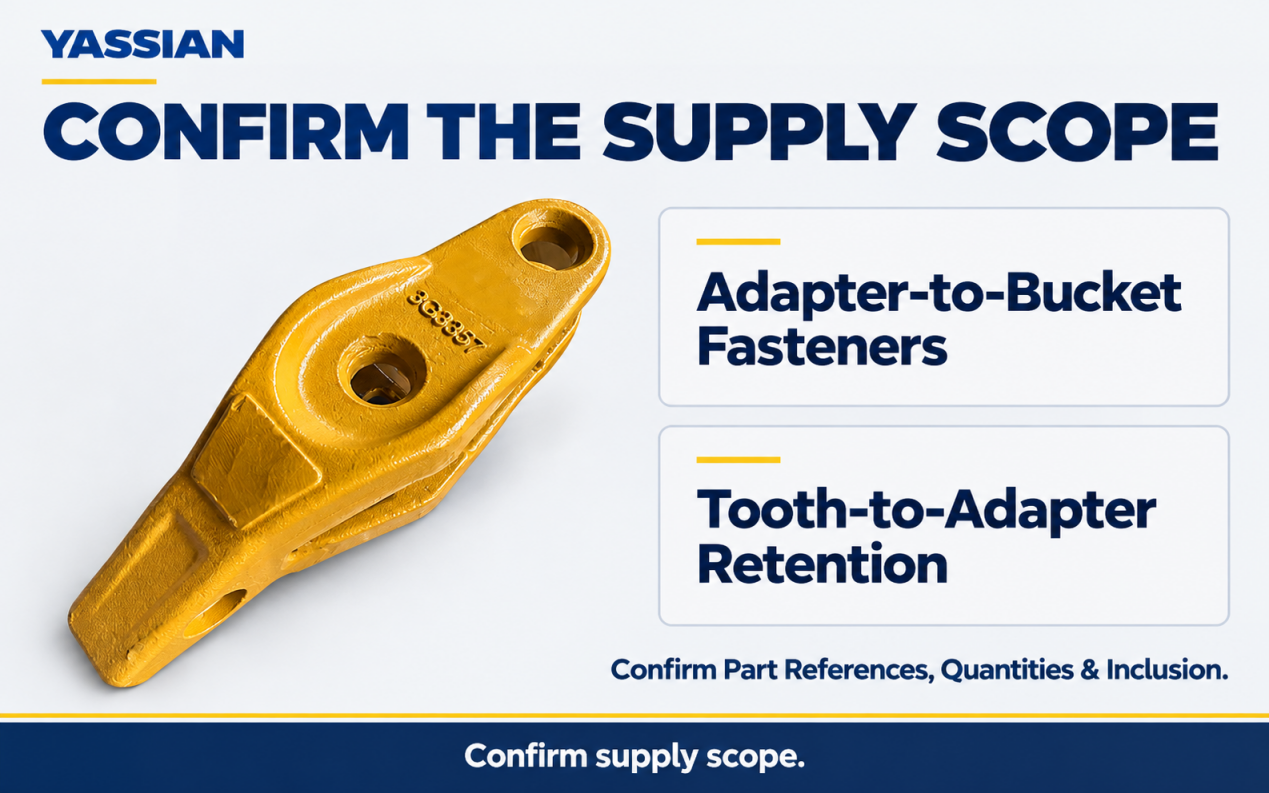
There are two connections to discuss: the adapter-to-bucket fastening and the tooth-to-adapter retention. A quotation should identify them separately.
Ask the supplier to list the proposed fastener and retaining-component references, quantities and inclusion status. Confirm thread specification, fastener length, seating arrangement and the applicable assembly instructions before ordering hardware.
A related-products list is not a packing list. Neither a catalogue recommendation nor a photograph establishes that bolts, nuts, pins, retainers or teeth are included in the adapter price.
Use the confirmed service procedure for installation and tightening. An unsuitable mounting interface should not be corrected by forcing the assembly together.
The following are general inspection considerations, not product-specific wear limits.
With the machine secured according to its service instructions, inspect accessible mounting faces, bolt holes, straps, the adapter nose and the retention area. Record visible wear, deformation, cracks or looseness for assessment by qualified maintenance personnel.
Inspect the bucket edge as well as the removed adapter. A new component cannot by itself correct damaged mounting faces or an unsuitable hole pattern. Also check the condition of the tooth and associated hardware.
Use the applicable service guidance to decide whether components can be reused or require replacement. Do not estimate remaining life from paint condition or photographs alone. Retain inspection photos with the maintenance record.
For an initial inquiry, provide:
Part reference, including any suffixes or additional markings.
Machine model, serial number and bucket identification.
Required installation position and quantity.
Overall, side, mounting-face and close-up photographs.
A drawing or measurements with clearly defined reference points.
Existing tooth reference and retention details.
Requested scope: adapter only or separately itemized components.
Material handled, operating conditions, destination and required delivery date.
For repeat orders, retain the approved drawing revision and sample reference. Agree on which dimensions will be checked and what inspection records are required.
Material, hardness, heat treatment and weight should refer to the quoted supplier's actual product. Request supporting records where these form part of the purchase specification. Confirm packaging, lead time and warranty terms in writing.
YASSIAN is a China-based factory supplier of construction machinery wear parts, G.E.T., undercarriage parts and related aftermarket replacements.


