
- All
- Product Name
- Product Keyword
- Product Model
- Product Summary
- Product Description
- Multi Field Search

When an excavator is working in rock, quarry, mining, compacted soil, or other abrasive ground conditions, the bucket tip is the first GET component to absorb the impact and abrasion of the material.
So, how do you select the right Heavy Duty Long Bucket Tip?
The answer is not simply to choose the largest or hardest bucket tooth available. The correct choice should balance machine compatibility, tooth profile, material characteristics, impact level, abrasion, penetration requirements, and expected wear life.
For heavy-duty applications, a long bucket tip can provide a useful combination of penetration and additional wear material. However, the tip must be correctly matched to the bucket adapter and operating conditions. Caterpillar's GET guidance similarly recommends selecting GET according to the attachment, application, machine, and material, while distinguishing heavy-duty tips from general-purpose designs according to wear and impact requirements.
For buyers sourcing aftermarket GET parts, the 264-2131 K130 Heavy Duty Long Bucket Tip is one example of a heavy-duty replacement solution available from YASSIAN.

A Heavy Duty Long Bucket Tip is a replaceable excavator or loader bucket tooth designed to provide greater wear material and a longer working profile than many general-purpose tooth designs. During excavation, it penetrates the material while absorbing repeated impact and abrasion.
YASSIAN's aftermarket GET range includes bucket teeth and adapters for excavators, wheel loaders, backhoe loaders, and mining equipment, with products designed for construction, quarrying, mining, and earthmoving applications.

A heavy-duty long tip is generally worth considering when the operating environment creates substantially more wear or impact than ordinary earthmoving.
Typical applications include:
Quarry operations can expose bucket tips to:
Limestone
Granite
Crushed rock
Aggregate
Highly abrasive mineral material
The combination of abrasion and impact can quickly wear a standard-purpose tip.
Mining equipment may operate for long shifts under continuous loading conditions. GET selection therefore becomes an important part of controlling maintenance and production costs.
Heavy Construction
Large excavators used for foundation excavation, road construction, trenching, and large-scale earthmoving may encounter compacted ground, mixed rock, and abrasive materials.
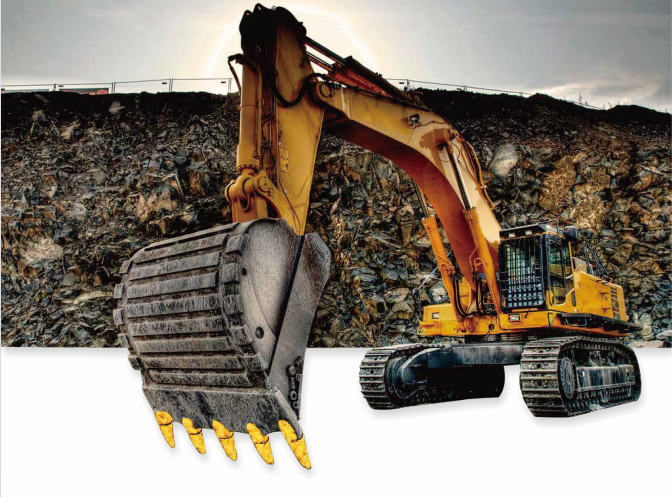
Frozen, cemented, compacted, or naturally hard ground requires sufficient penetration capability. A suitable long-profile tip can help maintain effective penetration as the tooth wears.
The harder and more abrasive the material, the more important it becomes to balance penetration, impact resistance, and wear life.
Before comparing materials or tooth profiles, confirm the machine, bucket, adapter, and GET system.
A bucket tip that looks similar externally may not be a correct replacement if the locking system, mounting dimensions, or adapter configuration differs.
For B2B buyers, provide your supplier with:
Machine make and model
Bucket model or size
Existing tooth part number
Adapter part number
Tooth photographs
Dimensions, if available
Application and material being excavated
This information allows the manufacturer to verify fitment rather than relying only on a visual comparison.
Different materials create different demands on GET.
Working Condition | Main Challenge | Selection Priority |
Loose soil | Penetration efficiency | Sharp/general-purpose profile |
Clay | Material penetration and release | Penetration-focused profile |
Gravel | Abrasion and moderate impact | Balanced wear resistance |
Rock | High impact and abrasion | Heavy-duty/rock configuration |
Quarry material | Severe abrasion | Wear resistance |
Mining | Continuous impact and abrasion | Heavy-duty or specialized GET |
The best tooth is the one that provides the right balance between penetration and wear life for the actual job.
One of the most common mistakes when choosing bucket teeth is treating all hard ground as the same.
Two sites may both be described as "rock excavation," but their GET requirements can be very different.
For example:
Highly abrasive but relatively low-impact material requires strong wear resistance.
Large, fractured rock with severe impact requires greater toughness and resistance to tooth breakage.
A tooth that is extremely hard is not automatically the best choice for every application. Excessive hardness without sufficient toughness can increase the risk of cracking or breakage under severe impact.
This is why professional GET selection should consider both:
Abrasion resistance + Impact resistance
rather than hardness alone.
Tooth geometry determines how efficiently the bucket enters the material.
A long, properly shaped bucket tip can help maintain penetration as the tooth gradually wears.
The profile should provide sufficient:
Tip penetration
Wear material
Working clearance
Bucket loading efficiency
However, increasing tooth length is not always better.
An excessively wide or heavy profile can increase resistance and may reduce digging efficiency in materials where penetration is already easy.
Caterpillar's GET guidance also emphasizes matching tip selection to application requirements, noting that different profiles are intended to balance penetration and wear according to operating conditions.
For heavy-duty bucket tips, material quality is critical.
A professional GET manufacturer should control both:
Material composition and Heat-treatment parameters
A suitable alloy steel formulation can provide the combination of toughness and wear resistance required for demanding excavation.
Heat treatment must then establish an appropriate hardness profile without making the component unnecessarily brittle.
When evaluating an aftermarket supplier, B2B buyers should ask about:
Alloy steel specification
Casting or forging process
Heat-treatment process
Hardness testing
Dimensional inspection
Quality-control procedures
Production traceability
YASSIAN states that its aftermarket bucket teeth are manufactured from high-impact alloy steel and processed using heat-treatment methods for applications including construction, quarrying, mining, and earthmoving.
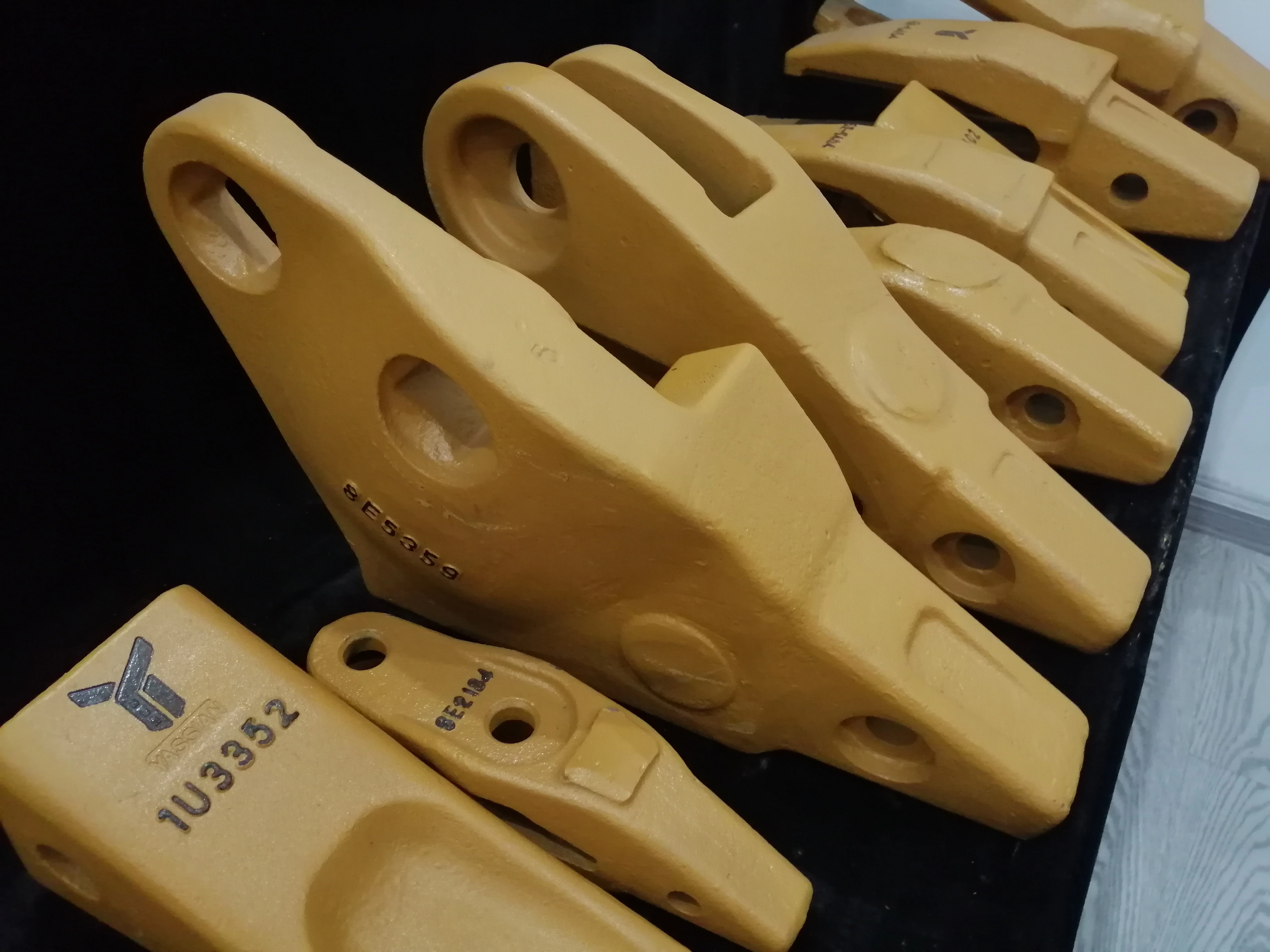
A new bucket tip cannot compensate for a worn or incorrectly matched adapter.
The adapter transfers excavation forces between the tooth and the bucket. If the adapter nose is excessively worn, the replacement tip may:
Fit loosely
Move excessively
Wear unevenly
Experience abnormal loading
Increase the risk of premature failure
Therefore, inspect the complete tooth-and-adapter system when replacing heavy-duty bucket tips.
For high-hour machines, replacing only the visible tooth without checking the adapter can result in repeated maintenance problems.
For B2B customers, the cheapest bucket tip is rarely the most economical solution.
A better evaluation is:
Total GET Cost = Purchase Cost + Replacement Labor + Downtime + Related Wear
Suppose two bucket tips have different purchase prices, but one requires significantly fewer replacements during the same operating period.
The lower-cost part may ultimately be more expensive if it causes:
More frequent machine stops
Higher labor requirements
Increased spare-parts inventory
Premature adapter wear
Reduced production
This is why fleet operators, mining contractors, and GET distributors should evaluate cost per operating hour or cost per ton, rather than purchase price alone.
For distributors and heavy-equipment operators, buying bucket tips should be treated as a technical sourcing decision rather than a simple commodity purchase.
An experienced ground engaging tools manufacturer should be able to support:
Part-number identification
GET system matching
Bucket tooth selection
Aftermarket replacement
Material and heat-treatment requirements
Bulk orders
Distributor programs
OEM/ODM requirements
YASSIAN's product range covers bucket GET, dozer GET, motor grader GET, hardware, wear protection, and undercarriage spare parts, allowing buyers to source multiple wear components through one supplier.
Before placing an order, confirm these points:
Machine: What excavator or loader is being used?
Bucket: What bucket type and size are installed?
Adapter: Which adapter system is currently used?
Part number: Is the existing tooth 264-2131 or another part number?
Material: Soil, clay, gravel, limestone, granite, or other material?
Abrasion: Low, medium, or severe?
Impact: Low, medium, or severe?
Priority: Penetration, wear life, or balanced performance?
Operating hours: How intensively is the machine used?
Supplier: Can the manufacturer verify fitment and provide consistent quality?
If these questions are answered before purchasing, the risk of selecting an unsuitable GET component can be significantly reduced.
Looking for heavy-duty excavator bucket tip? Contact YASSIAN with your machine model, existing part number, adapter information, and working conditions for a suitable GET solution.


