
- All
- Product Name
- Product Keyword
- Product Model
- Product Summary
- Product Description
- Multi Field Search

Choosing the wrong bucket teeth can lead to premature wear, broken tips, increased fuel consumption, and costly excavator downtime. In mining and quarrying, two commonly considered options are heavy abrasion bucket teethand rock bucket teeth.
But which one performs better in demanding conditions?
The answer depends on whether abrasive wear, rock impact, or material penetration is the main challenge.
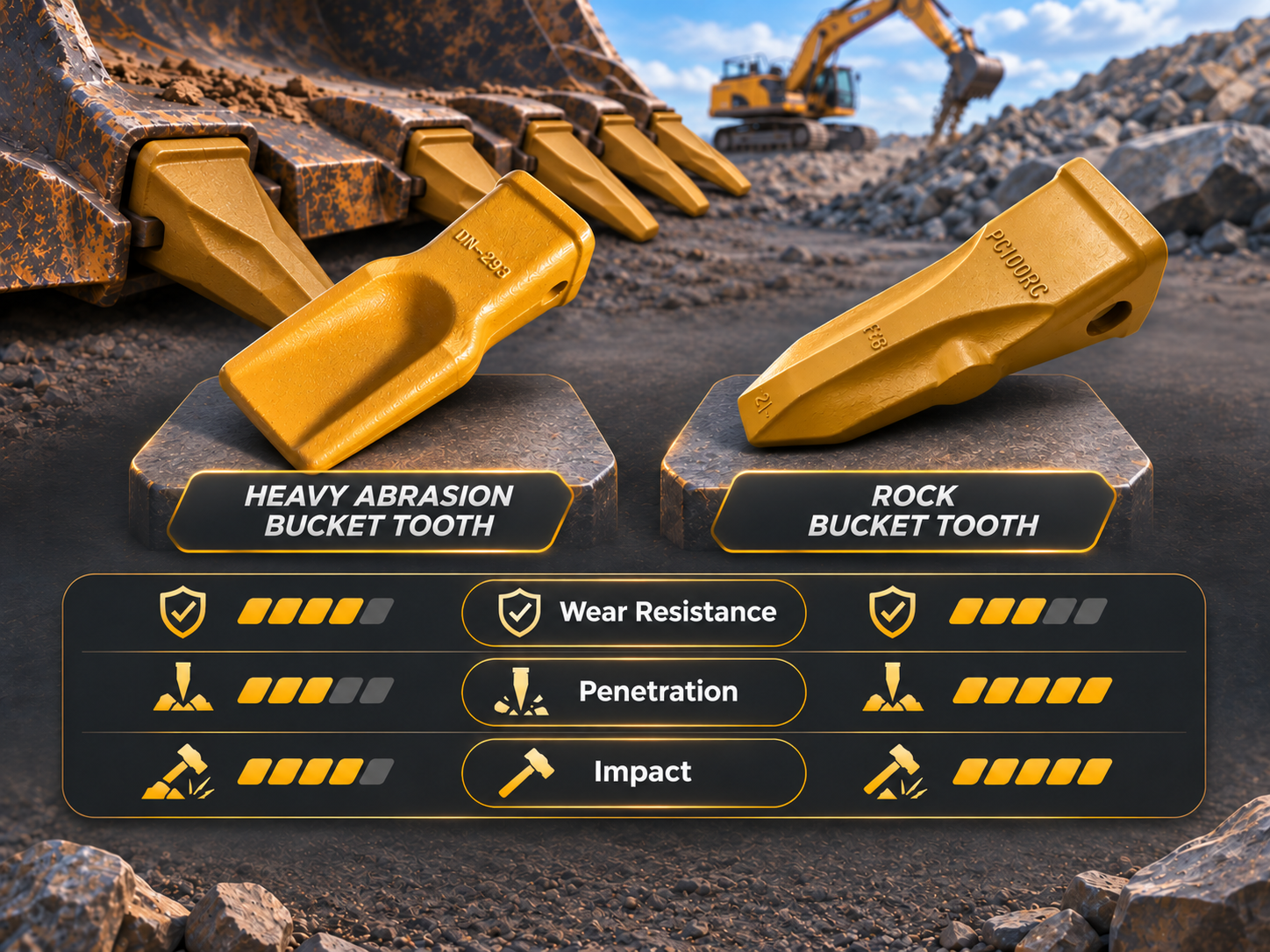
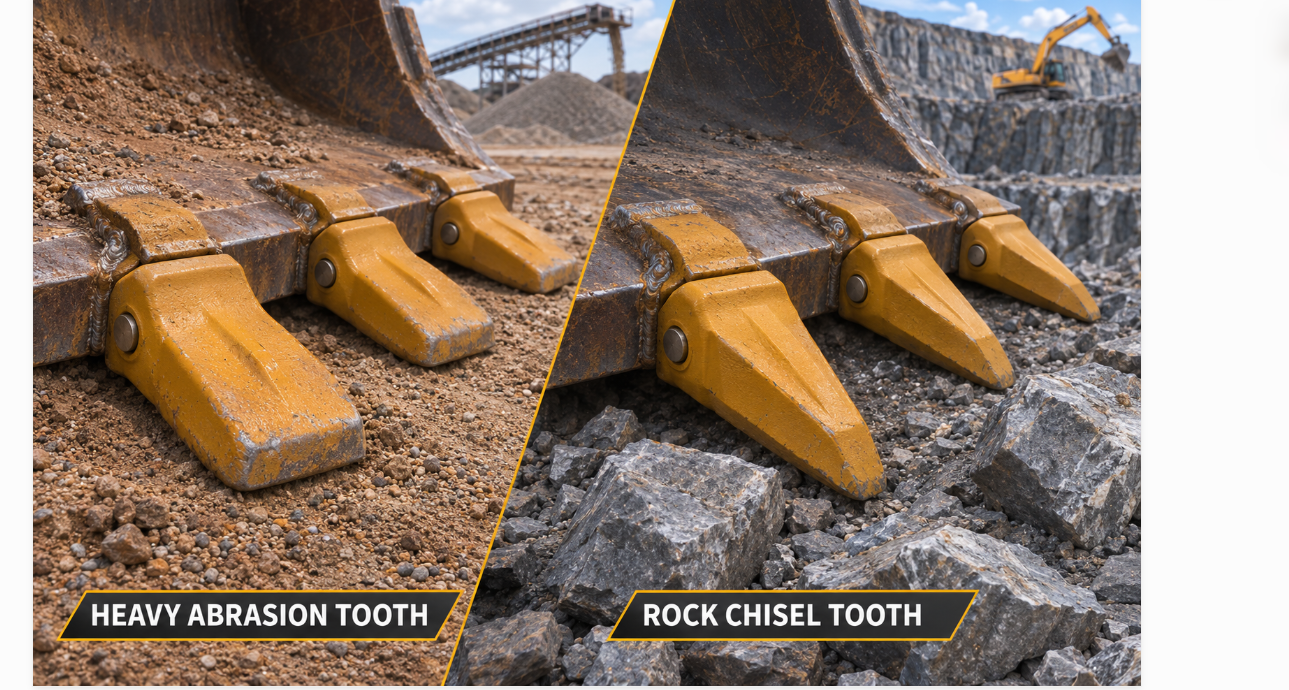
Heavy abrasion bucket teeth are generally better for highly abrasive materials such as sand, gravel, and crushed aggregate, where wear life is the primary concern. Rock bucket teeth are typically selected for hard or fractured rock excavation, where penetration and resistance to impact may be more important.
However, rock bucket teeth include different designs, such as rock chisel, rock penetration, and reinforced rock teeth. Some rock profiles also prioritize abrasion resistance.
The best choice depends on the balance between wear resistance, impact strength, penetration, and operating costs.
The most reliable approach is to match tooth design to the material and dominant wear mechanism.
Working Condition | Recommended Tooth Type | Main Reason |
Sand and gravel mining | Heavy abrasion | Continuous abrasive contact |
Crushed aggregate handling | Heavy abrasion | High surface wear |
Hard, compacted rock | Rock chisel / penetration | Greater penetration requirements |
Large fractured rock | Impact-resistant rock tooth | Higher shock and breakage risk |
Abrasive granite quarry | Heavy abrasion or reinforced rock tooth | Combined abrasion and impact |
Mixed mining conditions | Balanced heavy-duty design | Compromise between wear life and toughness |
Important: Rock hardness and abrasiveness are different properties. A hard material may require greater penetration force, while a highly abrasive material accelerates tooth surface wear.
When both abrasion and impact are severe, a specialized heavy-duty design may be more appropriate than either a conventional abrasion tooth or a standard rock tooth.
For B2B equipment buyers, the best bucket tooth is not necessarily the one with the lowest purchase price or longest theoretical wear life.
A complete evaluation should consider:
Tooth service life: Productive hours before replacement.
Replacement costs: Tooth price, pins, retainers, and maintenance labor.
Equipment downtime: Lost production during wear-related repairs.
Digging productivity: Material moved per hour.
A useful purchasing metric is:
GET Cost per Ton = (Tooth and Hardware Costs + Replacement Labor + Wear-Related Downtime Costs) / Total Tons Moved
For example, a heavy abrasion bucket tooth may provide better value in a gravel quarry if it reduces replacement frequency without compromising bucket loading.
Conversely, a rock chisel tooth may be more economical in difficult rock excavation if its penetration performance improves productivity enough to offset faster abrasive wear.
The ideal decision should be based on comparable field measurements rather than purchase price alone.
Before ordering replacement bucket teeth, equipment owners and distributors should evaluate four factors:
Material characteristics: Is the primary challenge abrasion, impact, or hard-ground penetration?
Tooth design: Does the profile provide the required balance of wear material, strength, and digging efficiency?
Equipment compatibility: Verify the tooth system, adapter dimensions, locking mechanism, and replacement part number.
Operating economics: Compare tooth consumption, replacement downtime, and cost per ton moved.
or severe applications, testing two suitable profiles under similar operating conditions provides more reliable evidence than comparing catalog descriptions alone.
With manufacturing experience dating back to 2002, YASSIAN supplies aftermarket ground engaging tools for construction, mining, quarrying, and earthmoving equipment.
Our bucket teeth and adapter range includes different profiles designed to accommodate varying excavation requirements.
YASSIAN supports B2B buyers through:
Wear-resistant alloy steel products: Manufactured with controlled heat treatment and quality inspection.
Multiple tooth configurations: Including general-purpose, rock chisel, penetration, and heavy-duty profiles.
OEM-compatible replacement options: For major earthmoving equipment brands.
Custom manufacturing: Based on part numbers, drawings, samples, and project requirements.
Wholesale supply: Supporting equipment distributors and international purchasing teams.
Our goal is to help customers select suitable GET solutions based on equipment compatibility, working conditions, and long-term operating value.
Choose heavy abrasion bucket teeth when wear life is the primary concern. Choose an appropriate rock bucket tooth when impact resistance or penetration is more important.
For mining and quarrying operations involving both severe abrasion and high impact, the right solution requires a carefully balanced GET design.
Selecting suitable teeth helps protect bucket components, maintain excavation efficiency, and control long-term operating costs.
Looking for reliable heavy abrasion or rock bucket teeth for your equipment?
Contact YASSIAN with your equipment model, part number, and application requirements to discuss suitable replacement bucket teeth and wholesale supply options.
Heavy abrasion teeth are generally preferable when abrasive wear is the dominant problem. Rock teeth may be better when hard-material penetration or severe impact is the priority. Neither is universally superior.
Yes. They can perform well in abrasive rock environments, provided their geometry, toughness, and mounting system are suitable for the expected impact loads.
Yes, but performance depends on the specific tooth design and material. Narrow rock-chisel profiles can provide strong penetration but may have less usable wear material than abrasion-focused alternatives.
Verify the equipment model, tooth system, OEM reference number, adapter compatibility, locking hardware, material requirements, and intended working conditions.


