
- All
- Product Name
- Product Keyword
- Product Model
- Product Summary
- Product Description
- Multi Field Search

A breaker breaks rock through the few square centimetres at the end of its tool. When output drops, the hammer, the carrier or the hydraulic oil usually get the blame, while the real cause is the wrong tip geometry, a shank that no longer guides straight, or a tool that should have been changed two shifts ago. This guide covers selection, shank fit and wear measurement.
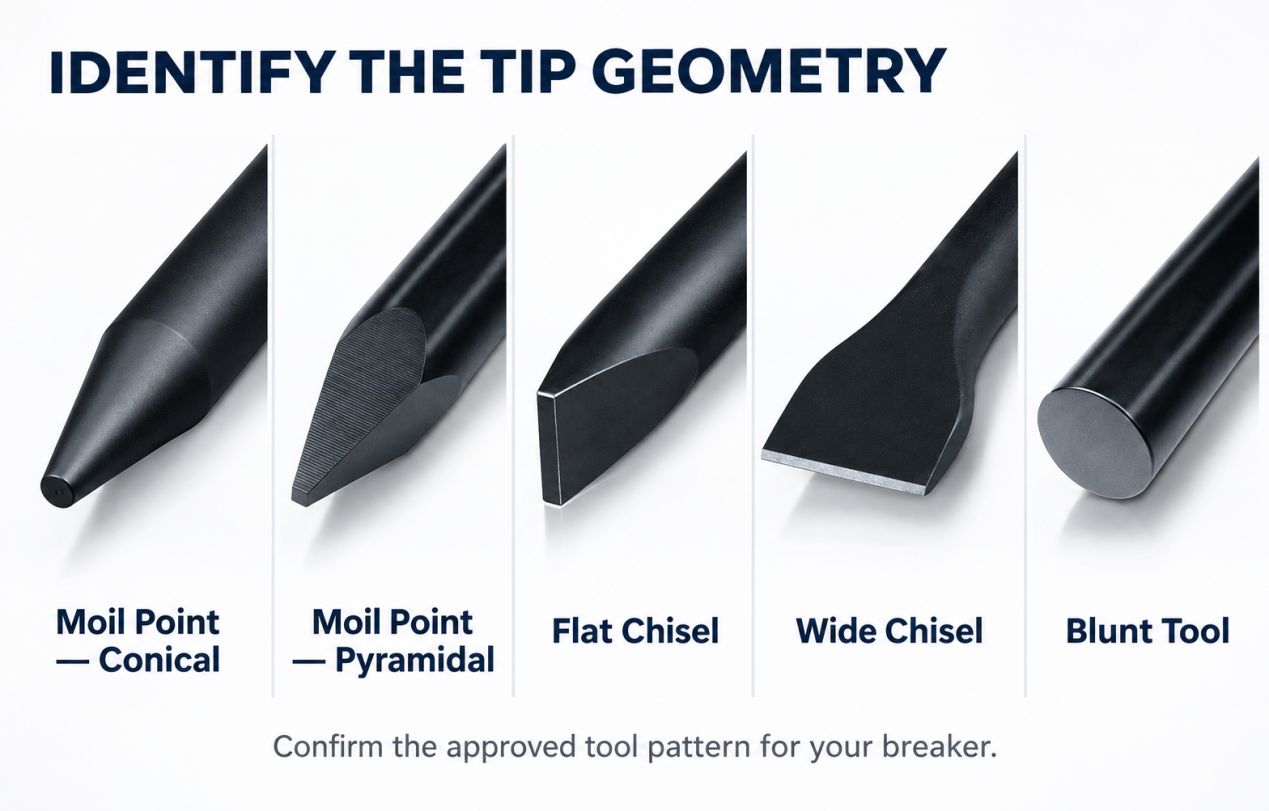
Impact energy leaves the piston as a stress wave. The tip shape sets the contact area, and therefore whether that wave starts a new crack, follows an existing plane of weakness, or simply crushes material at the surface.
A conical tip with a small contact area produces high point stress. It suits hard, brittle, homogeneous rock where a crack must be initiated, and general demolition work. It performs poorly in soft clay or asphalt, where the point penetrates instead of fracturing and can become stuck.
A blade-shaped edge concentrates stress along a line. This is the tool for bedded or stratified rock, trenching, and cutting along a joint. Orientation matters: the blade must sit across the intended split, and it must not be levered sideways to widen the opening.
A flat, truncated face spreads load over a wider area. It is used for secondary breaking of boulders and oversize blocks that are already fractured, for slag and layered material. In intact hard rock it is a weak primary tool, polishing rather than penetrating.
Multiple edges combine point penetration with a stronger tip section. These are common in reinforced concrete and mixed demolition, where a plain moil point deflects off rebar and loads the bushing sideways.
Profile | Contact pattern | Suitable work | Weak fit | Note when ordering |
Moil point | Point | Hard, brittle, homogeneous rock; general demolition | Soft clay, soft asphalt | Confirm tip cone angle against a drawing if available |
Flat / wide chisel | Line | Bedded rock, trenching, joint cutting | Massive rock with no free face | State blade width and orientation |
Blunt | Area | Secondary breaking, oversize blocks, slag | Intact hard rock as a primary tool | Face diameter matters more than length |
Pyramid / conical | Multiple edges | Reinforced concrete, mixed demolition | Very soft ground | Confirm the breaker maker approves the pattern |
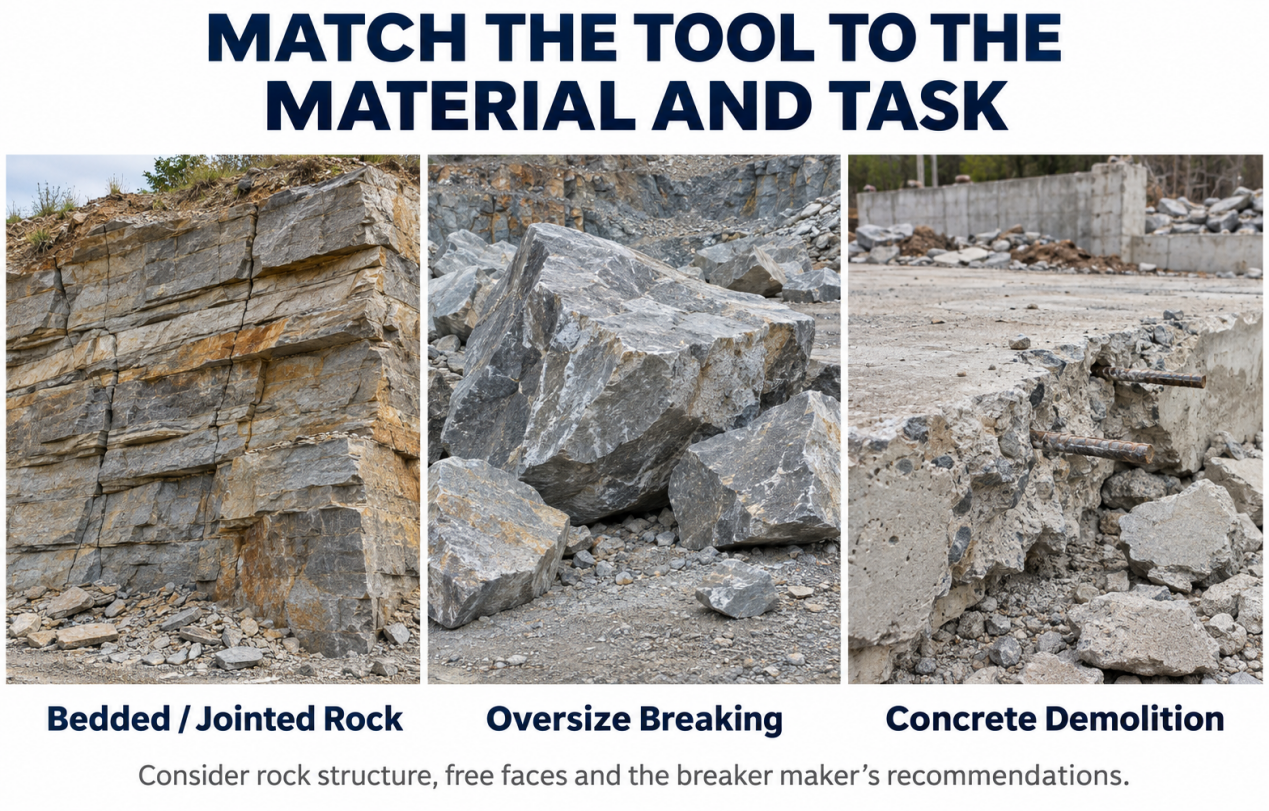
Hardness describes resistance to indentation, but structure often decides how easily a formation breaks: a hard rock with closely spaced joints can open faster than a softer, massive and tough one. Before choosing a tip, look at bedding planes, joint spacing, weathering and the free faces available.
Massive, non-stratified rock needs a point to start a fracture, then repositioning before the tip buries itself. Bedded sandstone or shale responds better to a chisel worked along the bedding from an exposed edge. In reinforced concrete, a point opens the section and the break is directed from an edge; a breaker is not a steel-cutting tool.
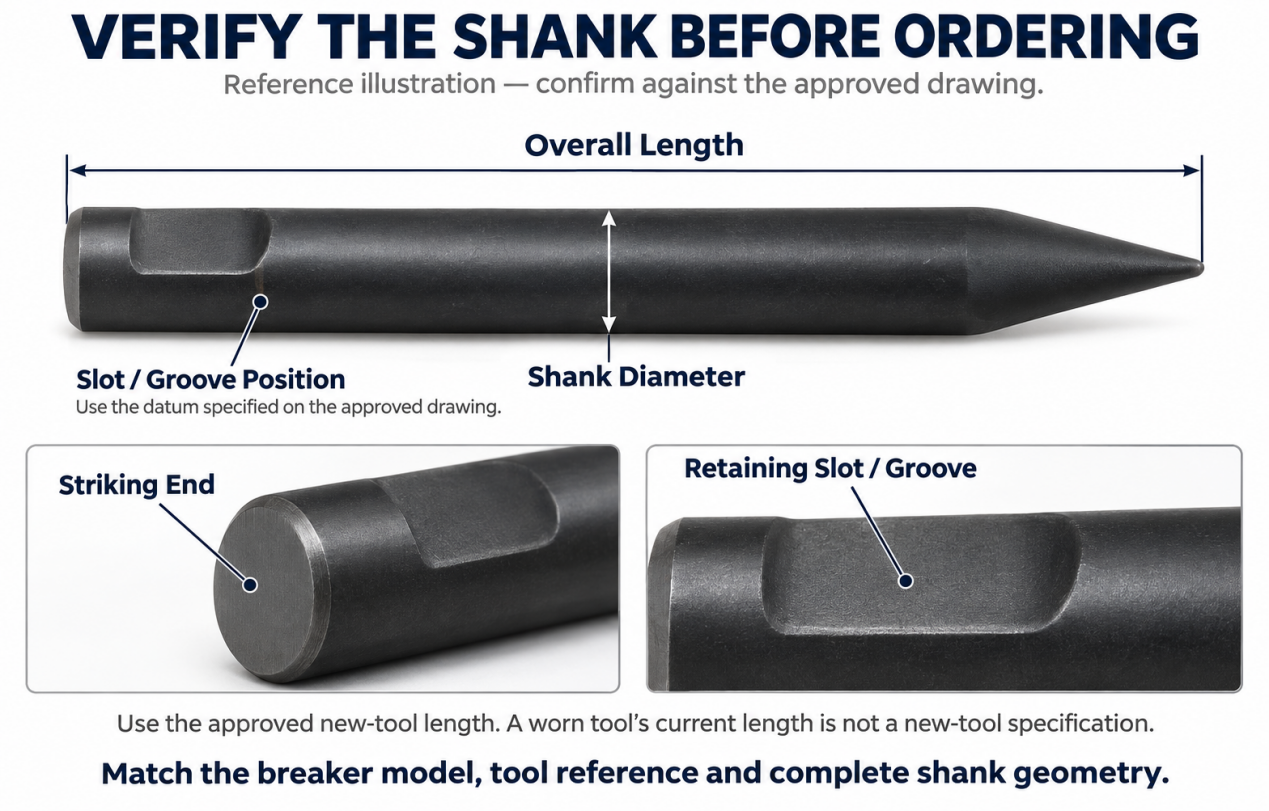
A "100 mm chisel" is not a specification. Before ordering, confirm:
Breaker make and model, and the tool reference in that maker's manual.
Shank diameter, measured with a caliper on an unworn section, not at the grooved end.
Overall length, including the striking face.
Top face profile — flat, chamfered or stepped — and its condition.
Retaining groove count and position, plus the collar or thrust ring position.
Bushing bore and clearance, since a new tool is only as good as the bore that guides it.
Fit matters both ways. A tool that is too tight can seize as it heats up; excessive clearance lets the shank tilt, wearing the bushing and bending the tool. Wrong grooves concentrate impact on the retainer pins.
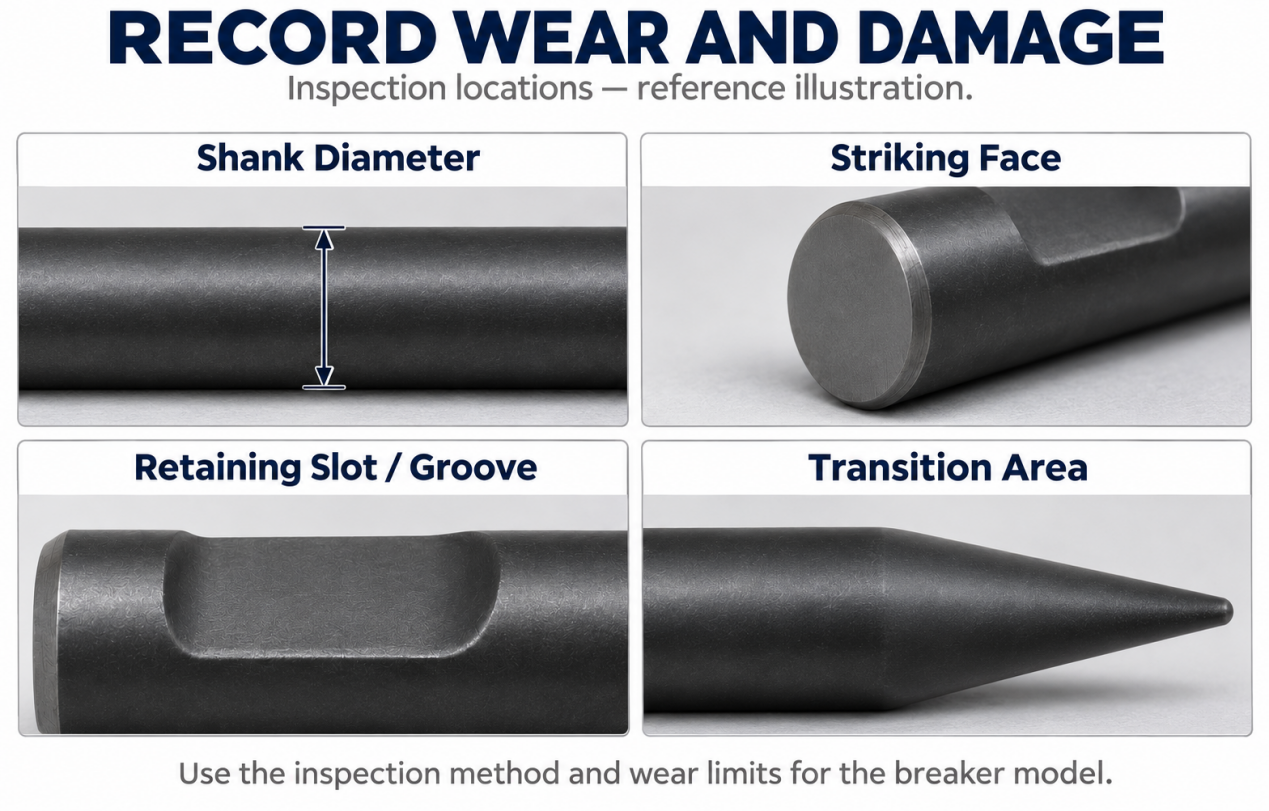
Record the following for every tool, with operating hours and rock type:
Tip width across the worn face, against the same measurement on a new tool.
Shank diameter at three heights: below the striking face, mid-shank, and just above the collar.
Straightness, checked by rolling the shank on a flat plate or against a straightedge.
Striking face condition, looking for mushrooming or a dished centre.
Cracks, especially at groove roots and at the transition into the collar.
Tool-to-bushing clearance, with a feeler gauge after the tool is pulled and refitted.
Apply the wear limits published in the breaker manufacturer's manual; they differ by model and bushing design. Where no figure is available, three practical rules help. Tip width growth: several suppliers quote 20–30% over the new dimension as a working trigger, which is supplier guidance rather than a standard. Clearance: one manufacturer's published figure for a medium-size breaker class is around 8 mm, and that figure is model-specific. Any mushrooming, groove-root crack or visible bend removes the tool from service regardless of measured wear.
Logging turns maintenance into planning: a fleet recording tip width every 250 hours can order before a tool fails mid-shift.
Grease the shank with a breaker-specific extreme-pressure grease rather than general chassis grease: published guidance from major breaker makers calls for manual lubrication of the working tool roughly every two hours, and more often in dust or high temperature. Fit the tool with clean bushings and the correct retaining pin, and check the retainer is fully seated before start-up.
Warm the carrier's hydraulic oil before breaking — one manufacturer's guidance is 40–60 °C, reached after about five minutes of gentle boom movement. Keep the tool at 90° to the working face, never pry with it, and stop impact as soon as the material yields, because blank firing sends an unrestrained stress wave through piston and tool.
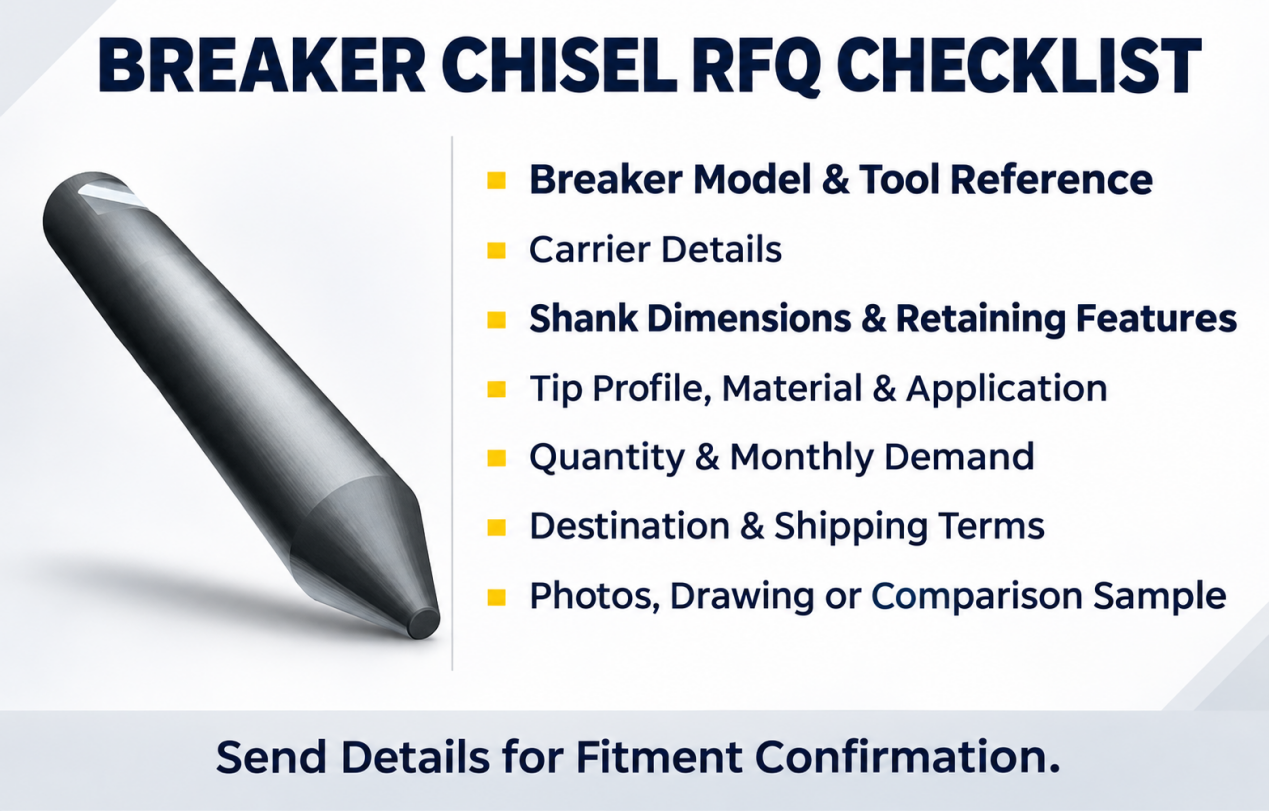
Send these seven items for a quote with no second round of questions:
Breaker brand and model, plus carrier make and operating weight.
Shank diameter, overall length, groove count and position, collar position — with a photo of the caliper on the shank.
Required tip profile, plus rock type and a photo of the working face.
Quantity, and expected monthly consumption if this is a stocking order.
Application: primary breaking, secondary breaking, trenching or demolition.
Destination country and port, packaging preference, Incoterm.
Whether an old tool can be sent as a sample for comparison.
YASSIAN has manufactured ground engaging tools and wear parts in Ningbo, China since 2002, supplying bucket teeth, adapters, cutting edges, ripper teeth, pins and retainers, chocky bars, grouser bars, undercarriage parts and breaker chisels to buyers in more than 80 countries. The breaker chisel range is published with moil point, wide chisel, chisel, blunt and percussion patterns, in alloy steel with a hardened working end and a tougher shank — see the breaker chisel range, the moil type chisel, the blunt tool chisel and the wedge type flat chisel.
To get a quote, send the breaker model, shank dimensions, tip profile, quantity, application and destination port, with photos of the worn tool and its tip. If the part number is unreadable, a caliper photo across the shank usually identifies the pattern.


