
- All
- Product Name
- Product Keyword
- Product Model
- Product Summary
- Product Description
- Multi Field Search

A weld-on adapter is the one wear part you cannot send back after installation. Once the straps are welded to the lip, the tooth angle, the pin alignment and the protection of the lip are fixed — and correcting a wrong opening means cutting, grinding and welding again, usually with the bucket off the machine. That is why the 2713-1220 adapter deserves more checking than the tooth that sits on it.
The 2713-1220 is a two-strap weld-on bucket adapter referenced to Doosan/Daewoo-style tooth systems. This guide covers what the part is, why one number reaches different buckets, and the four checks to finish before anyone strikes an arc.

The adapter sits between the bucket lip and the replaceable tooth. In a two-strap design, the rear body forms two parallel straps that straddle the lip: the lip enters the rectangular opening between them, and the straps are welded along the edge. The front nose projects forward and carries the tooth, which is held by a pin and a separate retainer.
The product photograph shows the casting clearly — a yellow-painted body with a raised 2713-1220 marking cast into the upper surface, two straps separated by a rectangular opening, and a round pin hole visible on the nose section. No tooth, pin or retainer appears in the photograph, and the image is not a dimensional drawing.
That matters for procurement: an adapter listing describes the adapter. Unless your quotation says otherwise, plan to order the tooth, pin and retainer separately, and confirm the supply scope in writing. YASSIAN supplies the 2713-1220 as an aftermarket replacement part, identified by the part number for compatibility purposes only.
Search for 2713-1220 and you will find catalogues that agree on the number and disagree on almost everything else. Published lip-opening figures differ, the suffix variants differ, and the machine lists differ. YASSIAN's own product record lists selected S290-5, S300-5, DX300 and DX300LC bucket configurations; other suppliers list DH280, DH300, DL500 and DX520.
Both lists can be right. A bucket is not a permanent specification: owners swap buckets, rebuild lips and fit third-party attachments, so one excavator model can arrive with three different lips after fifteen years of service.
The suffixes tell the same story. Catalogues show 2713-1220-40, -45 and -50 variants, generally understood to distinguish lip-opening or mounting configurations. They are not interchangeable, and a photograph of a painted adapter cannot tell you which one you are looking at: the marking in the supplied photo reads 2713-1220, with no visible suffix.
The tooth reference is a separate trap. Third-party catalogues pair this adapter family with more than one tooth number — 2713-1217 and 2713-1219 both appear, depending on the source and the tooth profile. Order a tooth from the adapter number alone and you may receive a point that will not seat.
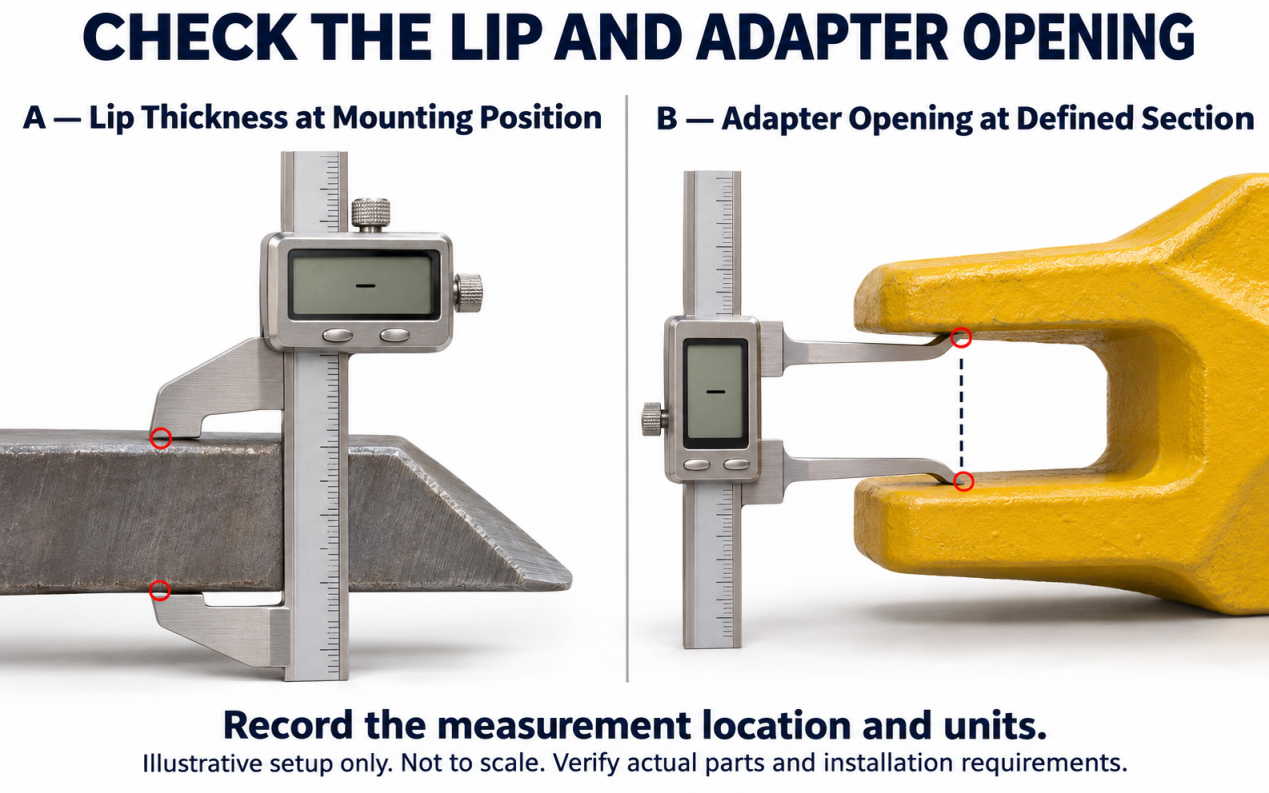
Take the measurement at the exact position where the adapter will sit, with a caliper, and write it down. Record lip thickness, lip width, edge bevel angle, the straight length available for welding, and the distance to the neighbouring tooth position.
Then measure the opening of the old adapter and the gap between the straps of the new one. If the two disagree, stop: you are looking at a different suffix or a different system, and no amount of weld will correct a strap that cannot close on the lip.
Measure what is on the machine, not what the manual says. A rebuilt or hard-faced lip is rarely at nominal thickness.
The nose is the interface, and it is also the part that wears first. Check the tooth cavity against the nose profile, the pin-hole diameter and its position relative to the nose shoulder, and the retaining style.
Look closely at the nose you are replacing. A nose worn into a step, gouged at the root or cracked where it meets the body will not hold a new tooth firmly, and a loose tooth hammers the adapter until both fail. If the nose is worn, replacing the adapter is usually cheaper than replacing teeth twice.
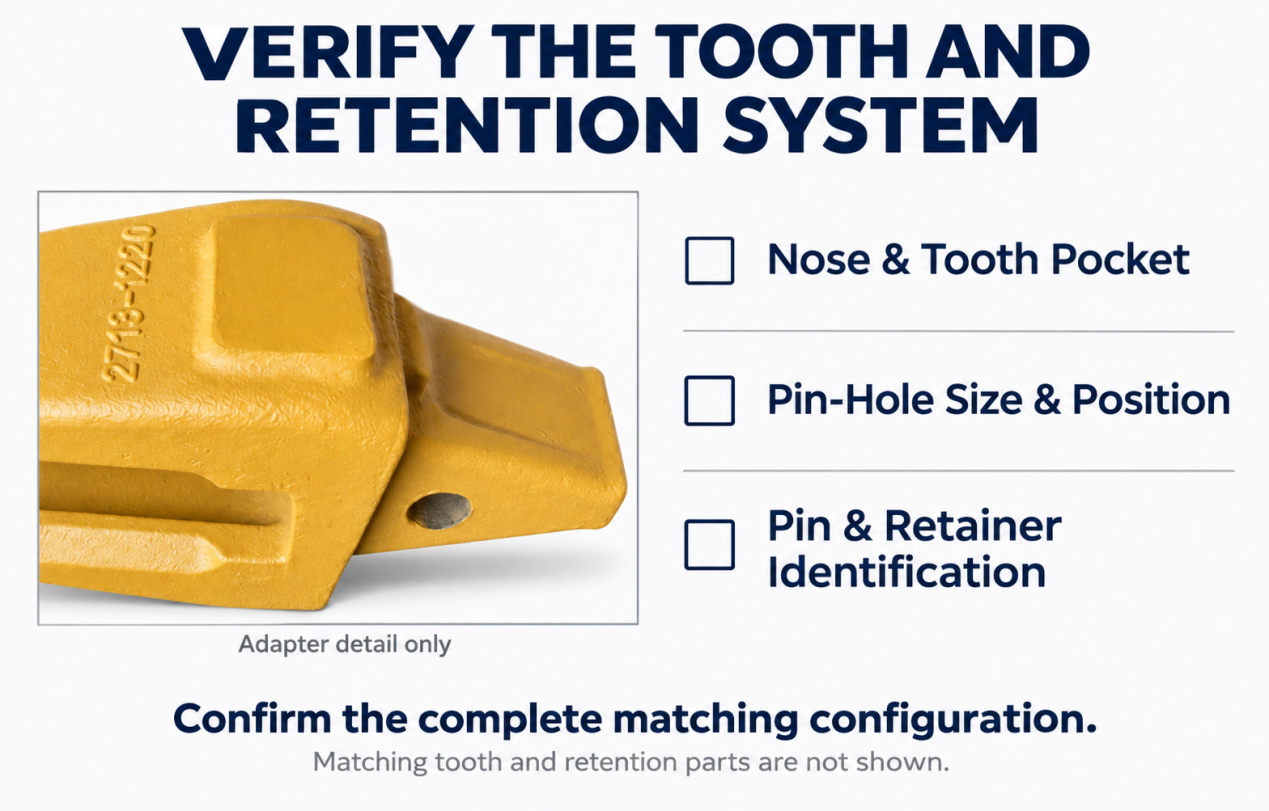
Third-party catalogues commonly list a 9J2358 pin with an 8E6359 sleeved retainer for this adapter family, but retaining arrangements vary within the same tooth series and should be checked against your bucket rather than assumed. Elongated pin holes are a wear item in their own right: a new pin in a worn hole will move, and a moving pin is how teeth are lost.
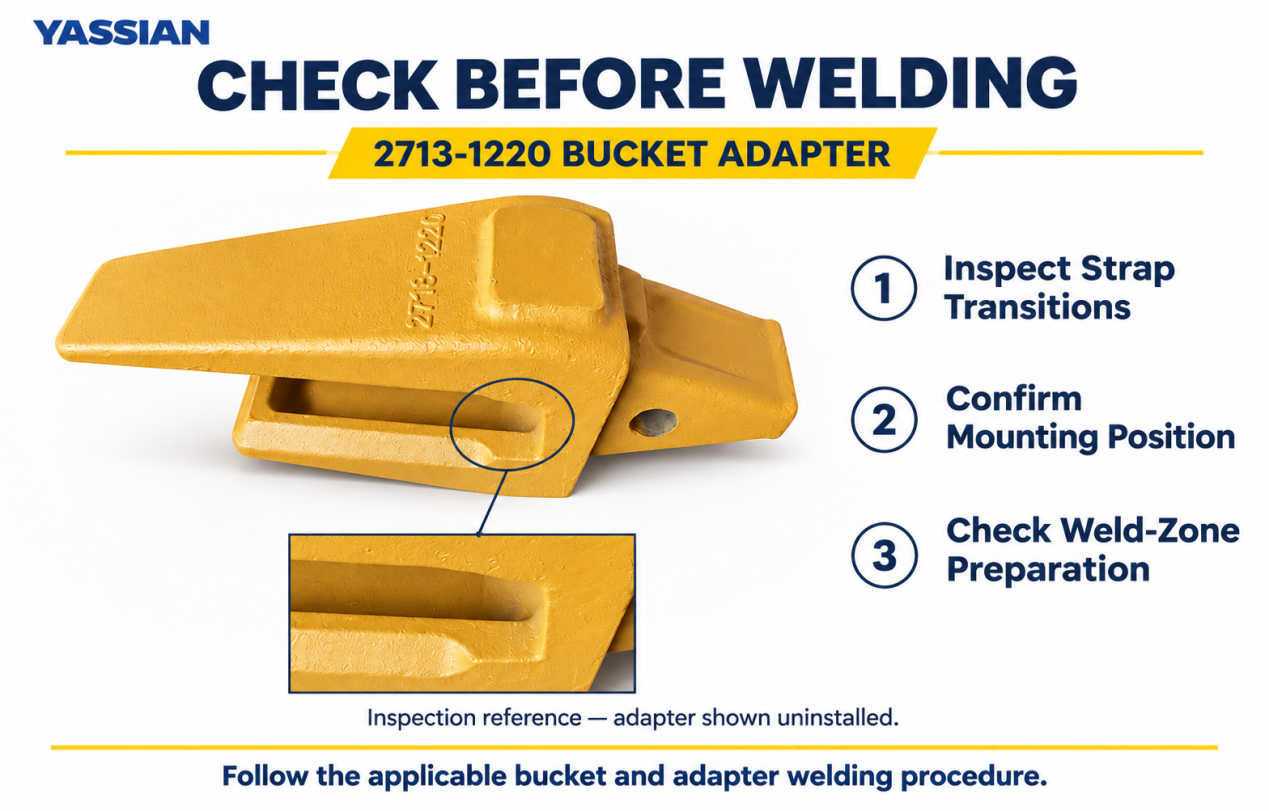
Check the straps for cracks at the body transition, deformation, and wear that has thinned the section. Cracks in this area rarely stay small under digging loads.
Welding is irreversible, so agree the procedure before starting: base metal and filler matching, preheat where required, a sequence that limits distortion, and clean bare metal at the weld zone. Do not weld with the tooth installed — heat and spatter damage the pocket and the pin hole. If the position is a corner, confirm that you have the corner configuration rather than a centre adapter, because the two are not interchangeable even when the nose looks identical.
Stock adapters by measured opening, not by machine brand, and label the bin with the gap you verified. Keep suffixes separate; a mixed bin is how a wrong part reaches a customer. Quote adapter, tooth, pin and retainer as a set, and state clearly which positions are centre and which are corner.
The part number as cast on the old adapter, including any suffix
Machine make, model and serial number, plus the bucket's own identification if it has one
Photographs of the old adapter on the bucket, the lip, and the machine plate
Lip thickness at the mounting position, the adapter opening measurement, and a drawing if available
The tooth number in use, and whether pin and retainer are required
Quantity, application (general excavation, quarry, demolition) and destination
YASSIAN has manufactured ground engaging tools in Ningbo, China since 2002, supplying bucket teeth, adapters, cutting edges, ripper points, pins and retainers, chocky bars, grouser bars, undercarriage parts and hydraulic breaker chisels to customers in more than 80 countries. Send the details above and our team will check the configuration against your bucket before production.


