
- All
- Product Name
- Product Keyword
- Product Model
- Product Summary
- Product Description
- Multi Field Search

Which bucket tooth provides better penetration and digging efficiency when excavating hard, compacted soil?
Tiger Long Bucket Teeth generally outperform standard bucket teeth in hard, compacted soil because their narrow, pointed profiles concentrate digging force into a smaller contact area. This helps excavators penetrate dense clay, hardpan, and compacted ground more effectively.
Standard bucket teeth, however, remain a practical choice for general excavation, loose soil, and mixed earthmoving applications where balanced wear life and versatility are more important than maximum penetration.
The best option depends on soil hardness, abrasion, excavator breakout force, and tooth durability. This distinction aligns with bucket tooth selection guidance from Caterpillar and Bobcat, which highlights the advantages of penetration-style teeth in compacted ground.
Feature | Tiger Long Bucket Tooth | Standard Bucket Tooth |
Tooth profile | Long, narrow, pointed | Broader, general-purpose |
Hard soil penetration | Typically superior | Moderate |
Compacted clay | Highly suitable | Suitable for lighter conditions |
Loose soil excavation | Effective but may be unnecessary | Highly suitable |
Abrasive wear resistance | Depends on material and design | Depends on material and design |
Impact resistance | Requires appropriate tooth toughness | Depends on tooth construction |
Main advantage | Concentrated penetration force | Versatility and balanced performance |
Best application | Hardpan, dense clay, compacted soil | General construction and earthmoving |
Key takeaway: Tiger Long teeth prioritize penetration, while standard bucket teeth provide a more versatile solution for everyday excavation.
When excavating compacted soil, the tooth tip must overcome substantial material resistance.
The narrow profile of a Tiger Long Bucket Tooth concentrates the available digging force over a smaller contact area, creating higher localized pressure at initial contact.
This can help the bucket enter resistant material more easily than a broader standard tooth.
Dense clay, hardpan, and compacted subgrade often resist conventional digging teeth.
Tiger-style teeth are designed for these demanding conditions. Their pointed cutting geometry can improve initial penetration and help fracture compacted material.
Caterpillar identifies penetration-style teeth as suitable for compacted ground, while Bobcat recommends tiger teeth for tightly compacted soil, hardpan, and clay.
Better penetration can reduce repeated digging attempts when the machine has sufficient breakout force.
Potential operational benefits include:
Fewer unsuccessful bucket-entry attempts
More consistent digging in compacted material
Reduced resistance during initial ground penetration
Improved productivity in suitable applications
However, actual cycle-time and fuel-efficiency improvements depend on machine capacity, tooth condition, bucket geometry, and site conditions. They should be verified through field testing rather than assumed.

PC300TL Tiger Long Bucket Tooth—Aftermarket Replacement
Selecting the correct tooth profile is essential for maintaining excavation productivity and controlling GET replacement costs.
Ground condition | Recommended tooth type | Main reason |
Loose sand and topsoil | Standard | Versatile, efficient general digging |
Soft to medium clay | Standard / penetration | Balanced digging performance |
Dense clay and hardpan | Tiger Long | Strong initial penetration |
Highly compacted soil | Tiger Long | Concentrated cutting force |
Gravel and abrasive soil | Reinforced / abrasion-resistant | Greater wear resistance |
Solid or high-impact rock | Heavy-duty rock tooth | Improved impact and wear capability |
Tiger Long teeth are not automatically the best solution for solid rock. Severe impact and abrasion may require a specialized heavy-duty rock tooth with greater structural strength and wear material.
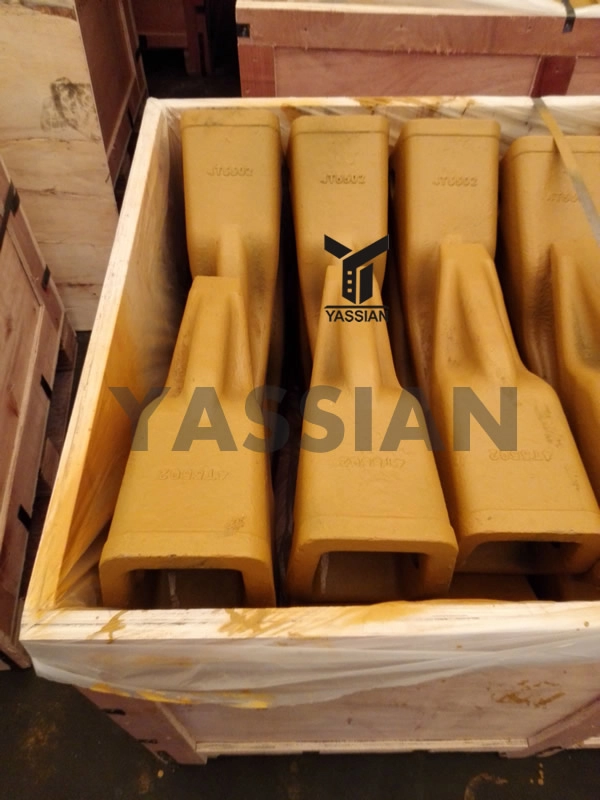
Not necessarily.
Although Tiger Long teeth can improve penetration in hard soil, their narrow tips may experience accelerated wear or damage in highly abrasive or severe-impact conditions.
Bucket tooth lifespan primarily depends on three factors:
Material and heat treatment: Properly manufactured alloy steel teeth must balance surface hardness with sufficient toughness to resist cracking.
Working conditions: Compacted clay, abrasive sand, gravel, and fractured rock create different wear patterns.
Tooth geometry: Narrow penetration tips concentrate force, while broader or reinforced profiles may provide more wear material.
For B2B buyers, the most useful performance measurement is often cost per operating hour, rather than purchase price alone.
GET Cost per Hour = (Tooth Cost + Replacement Labor + Downtime Cost) / Operating Hours
A higher-priced tooth can provide better overall value if it delivers sufficient additional service life or productivity.
Before ordering replacement Tiger Long Bucket Teeth, verify the following specifications:
Excavator model and bucket size: Confirm that the tooth is suitable for the equipment and intended operating conditions.
Adapter compatibility: Check the tooth system, adapter part number, mounting dimensions, and locking mechanism.
Material properties: Evaluate alloy steel quality, heat-treatment consistency, hardness, and impact toughness.
Working environment: Determine whether penetration, abrasion resistance, or impact strength is the primary requirement.
Replacement economics: Compare purchase cost, expected operating life, and maintenance requirements.
Correct adapter matching is especially important because visually similar teeth may use incompatible mounting systems.
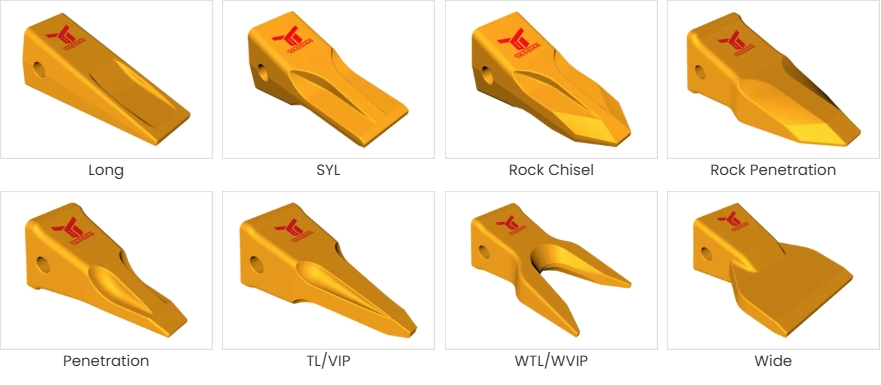
As a professional manufacturer and supplier of ground engaging tools, YASSIAN provides aftermarket bucket teeth, adapters, and related GET components for construction, earthmoving, quarrying, and mining applications.
YASSIAN's product range includes general-purpose, long-profile, penetration, tiger-style, and rock bucket teeth for different excavation requirements. Its published product information describes alloy steel manufacturing and heat-treatment processes designed to support wear resistance and impact performance.
For distributors, equipment parts importers, and construction contractors, selecting the right tooth requires both application knowledge and reliable product compatibility.
Explore YASSIAN's excavator bucket teeth and GET solutions to find suitable replacement options.
Looking for reliable Tiger Long Bucket Teeth or other excavator GET parts? Contact YASSIAN for product specifications, compatibility assistance, and wholesale inquiries.
Q: Are Tiger Long Bucket Teeth better for compacted clay?
A: Generally, yes. Their pointed geometry helps concentrate digging force, making them suitable for dense clay and compacted soil where standard teeth may struggle to penetrate.
Q: Can Tiger Long Bucket Teeth be used for rock excavation?
A: They may be suitable for certain fractured or penetrable rock conditions. However, heavy-duty rock teeth are usually preferable where severe impact or abrasion is the dominant challenge.
Q: Do Tiger Long Bucket Teeth reduce fuel consumption?
A: They may improve digging efficiency in suitable hard-soil conditions, potentially reducing wasted digging effort. Actual fuel savings depend on operating conditions and require measured comparisons.
Q: Are Tiger Long Bucket Teeth compatible with all excavators?
A: No. Compatibility depends on the bucket adapter system, tooth dimensions, retention components, and applicable part numbers.


