
- All
- Product Name
- Product Keyword
- Product Model
- Product Summary
- Product Description
- Multi Field Search

An excavator idler may look like a relatively simple undercarriage component, but choosing the wrong one can lead to installation problems, uneven track wear, poor track alignment and unnecessary downtime. Two idlers may appear almost identical while having different shaft sizes, tread widths, flange profiles or mounting dimensions.
For this reason, buyers should never select an excavator front idler based only on appearance, machine tonnage or price. Correct identification requires a combination of machine information, reference part numbers, critical dimensions, track compatibility and working conditions.
This guide explains how to choose the right replacement excavator idler and which details you should verify before placing an order.
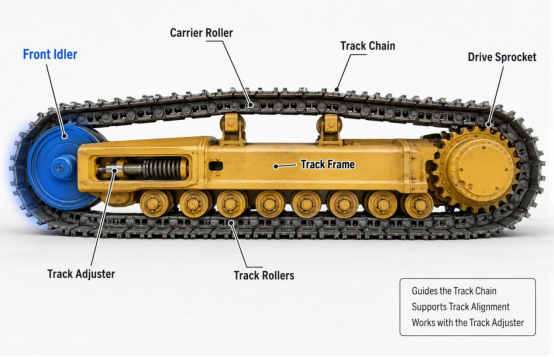
The front idler is normally installed at the front of a crawler excavator's track frame. It guides the track chain around the front of the undercarriage and helps keep the chain correctly aligned during machine travel.
Its main functions include:
Guiding the track chain
Supporting correct track alignment
Working with the track adjuster and recoil mechanism
Absorbing travel-related shock
Helping reduce the risk of track derailment
The idler does not independently adjust track tension. Instead, it moves within the track frame and works together with the grease adjuster and recoil spring assembly. Incorrect track tension can accelerate wear on the idler, track links, rollers and sprocket.
Because these components operate as a system, selecting the correct excavator idler is essential for reliable undercarriage performance.
Before looking at excavator idler dimensions or product photos, identify the machine as accurately as possible.
Provide the supplier with:
Machine brand
Complete machine model
Machine serial number
Production year, if available
Undercarriage configuration
OEM or reference part number
The complete model is important because machines with similar names or operating weights may use different undercarriage parts. Even the same excavator model can have component changes between production years or serial-number ranges.
A serial number helps distinguish different machine versions and reduces the risk of ordering a part designed for another configuration.
An OEM or reference part number is one of the most useful identification details. It may be found in the machine parts manual, dealer catalog, maintenance records, previous purchase documents or markings on the old component.
However, a part number should still be cross-checked with the machine model and dimensions. Manufacturers sometimes replace an older number with a new one, while aftermarket catalogs may use different cross-reference formats.
If the original part number is unavailable, send the supplier clear photographs of:
The complete machine
Machine nameplate
Existing front idler
Idler shaft ends
Mounting area
Track chain
Any visible markings
These details allow an experienced excavator idler supplier to narrow down the correct product more reliably.
Measure the Existing Excavator Idler

When the machine information or part number is incomplete, accurate measurements become especially important.
Depending on the idler design, the supplier may request:
Overall idler diameter
Tread diameter
Overall width
Tread width
Flange or guide width
Shaft diameter
Shaft length
Mounting width
Distance between mounting surfaces
Track-chain pitch
Clean away mud, grease and packed material before measuring. Use a caliper or another suitable measuring tool and record all values in millimetres.
Whenever possible, measure an unworn area. A heavily worn tread or flange will not represent the original nominal dimension. It is also helpful to photograph the measuring tool in position so that the supplier can see exactly how each measurement was taken.
Dimensions should not be used alone. Two idlers with similar diameters may still have different shaft ends, mounting structures, flange profiles or internal designs.
The excavator front idler must work correctly with the track chain and surrounding undercarriage components. Its tread and guide profile should match the path of the track links.
An incorrect profile or width may cause:
Side contact with the track links
Uneven flange wear
Abnormal noise
Track-chain misalignment
Increased risk of derailment
Before installing a new idler, inspect the track links, bushings, track rollers, carrier rollers, sprocket, track adjuster and idler guides. A new component may wear quickly if it operates with a severely worn or misaligned undercarriage.
Repeated track problems are not always caused by the idler itself. Excessive track tension, a damaged adjuster, worn links or packed debris can produce similar symptoms.
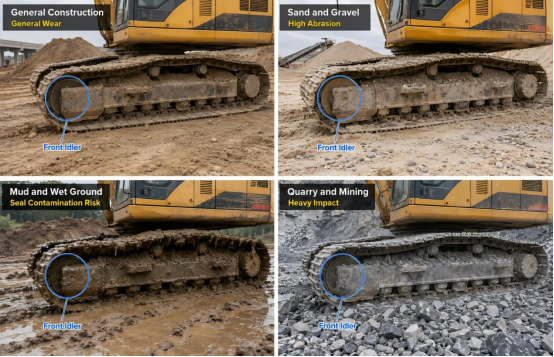
The best excavator idler is not determined only by machine compatibility. It should also be suitable for the actual application.
General construction work usually requires a reliable balance of wear resistance, impact strength and cost. Quarry and mining operations may expose the idler to abrasive rock, high loads, repeated shock and long working hours. These conditions place greater demands on the idler body, tread, shaft, bushing and sealing system.
Muddy or wet environments can allow contaminants to accumulate around the undercarriage. Sand and fine mineral particles may accelerate wear on the tread, flanges and seal areas.
When requesting a quotation, tell the supplier whether the machine operates in:
Soil and general earthmoving
Sand and gravel
Mud or wet ground
Quarry applications
Mining operations
Demolition sites
Extremely hot or cold environments
This information helps the supplier recommend a product specification appropriate for the application.
Price is important, but it should not be the only purchasing criterion. The service life of an aftermarket excavator idler also depends on material selection, heat treatment, machining, assembly and quality control.
Key areas to evaluate include:
The body should provide sufficient structural strength and impact resistance. The tread requires controlled heat treatment to improve wear resistance while retaining adequate core toughness. A product that is simply described as "very hard" is not automatically better because excessive hardness without adequate toughness may increase the risk of cracking.
Accurate machining and suitable internal clearances support stable rotation. Poor alignment or incorrect fit can cause abnormal play, heat generation and premature internal wear.
A reliable sealing system helps retain lubricant and limit the entry of dirt, water and abrasive particles. Ask the supplier how the idler is lubricated and whether rotation and leakage are checked during inspection.
Consistent mounting and running dimensions are essential. Reliable manufacturers should inspect critical measurements instead of relying only on visual checks.
OEM parts generally provide established machine identification and dealer support, but they may involve higher purchasing costs or longer regional delivery times.
A properly verified aftermarket excavator idler can offer competitive pricing, flexible order quantities and better availability for older machines. However, buyers should confirm more than a cross-reference number.
Ask for information about:
Machine compatibility
Reference part number
Product dimensions
Material specification
Heat-treatment control
Seal and lubrication design
Inspection procedures
Packaging
Warranty or quality policy
The right choice depends on compatibility, verifiable quality, working conditions, delivery requirements and total operating cost—not simply whether the product is OEM or aftermarket. YASSIAN manufactures its products using materials sourced from the world's largest steel mills and other top-tier suppliers, with quality inspections conducted by professional engineers.
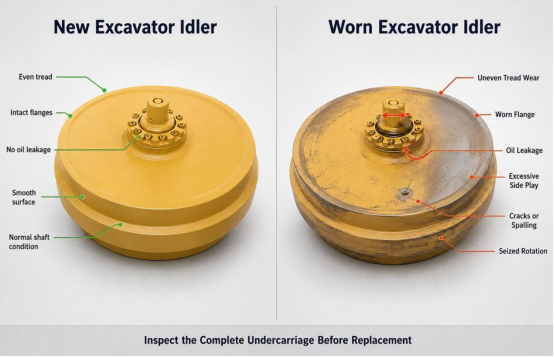
Common signs that an excavator idler may require inspection or replacement include:
Excessive or uneven tread wear
Damaged or thin flanges
Oil leakage
Difficult or seized rotation
Excessive side play
Cracks or surface spalling
Abnormal noise during travel
Repeated track misalignment
If cracks, severe looseness, seizure or repeated track derailment are present, stop the machine and have the complete undercarriage inspected by a qualified technician.
To receive an accurate quotation, provide:
Machine brand and complete model
Machine serial number
OEM or reference part number
Photos of the existing idler
Photos of the mounting area
Critical dimensions
Required quantity
Destination country or port
Working conditions
Any other undercarriage parts required
This information helps the supplier verify compatibility, reduce identification errors and prepare a more accurate quotation.
Choosing the right excavator idler requires more than finding a part that looks similar. Buyers should confirm the machine model, serial number, reference part number, critical dimensions, track-chain compatibility and operating conditions before ordering.
Product quality should also be evaluated through material selection, heat treatment, shaft and bushing accuracy, sealing performance and dimensional inspection. At the same time, the condition of the track chain, rollers, sprocket, adjuster and idler guides should be checked to prevent a new idler from wearing prematurely.
By providing complete machine information, product photos and accurate measurements, distributors, repair companies and equipment owners can select a compatible replacement excavator idler, reduce downtime and improve overall undercarriage reliability.
Are you looking for a reliable manufacturer? Please contact YASSIAN, we are confident that our products and services will meet your expectations.


