
- All
- Product Name
- Product Keyword
- Product Model
- Product Summary
- Product Description
- Multi Field Search

Excavators often work in dusty construction sites, quarries, mines and other demanding environments. In these conditions, the engine air-intake system is constantly exposed to dust and airborne particles. An excavator air filter helps reduce contaminants entering the intake system and is therefore an important replacement component for heavy equipment.
Although an air filter may look simple from the outside, the actual air filter manufacturing process involves many stages, including filter media preparation, pleating, supporting mesh production, end-cap forming, bonding, curing, assembly and final inspection.
For distributors, importers and equipment parts buyers, understanding how an excavator air filter is made can help evaluate products beyond appearance and price.
An excavator air filter is part of the engine air-intake filtration system. Its main purpose is to help prevent airborne contaminants from entering the engine through the intake air.
Because construction equipment frequently operates around soil, sand and dust, air filtration is especially important in heavy-duty applications.
Different machines may use different filter dimensions, sealing structures and element designs. Similar-looking filters should therefore not automatically be treated as interchangeable.
Correct replacement normally requires checking the relevant part number, machine model, engine model, dimensions and installation structure.
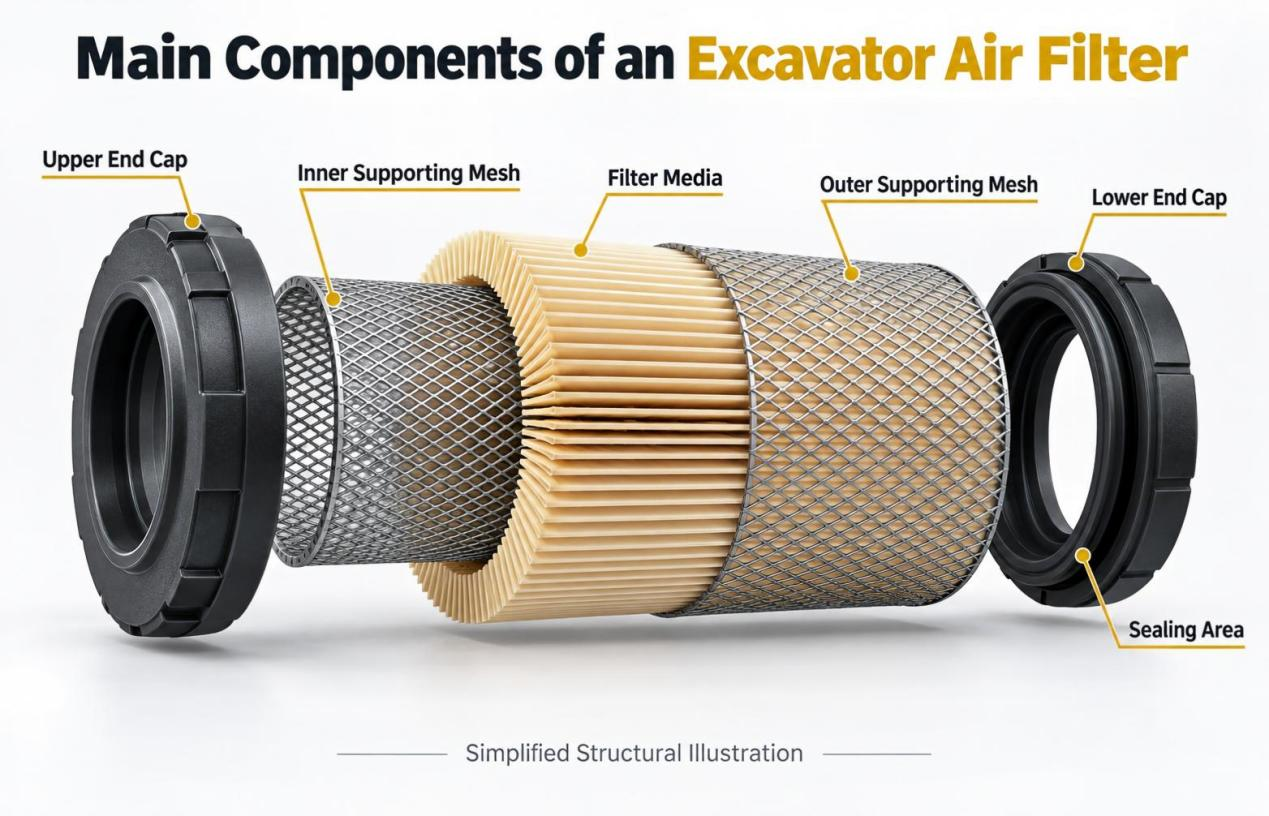
A typical heavy-duty air filter element includes several important components:
Filter media — the main filtration material
Inner and outer supporting mesh — helps maintain the shape and structure of the element
Upper and lower end caps — secure the filter element at both ends
Sealing and bonding areas — connect the media, mesh and end caps during assembly
The production document separates the manufacturing process into filter paper, supporting mesh, end caps and final filter assembly.
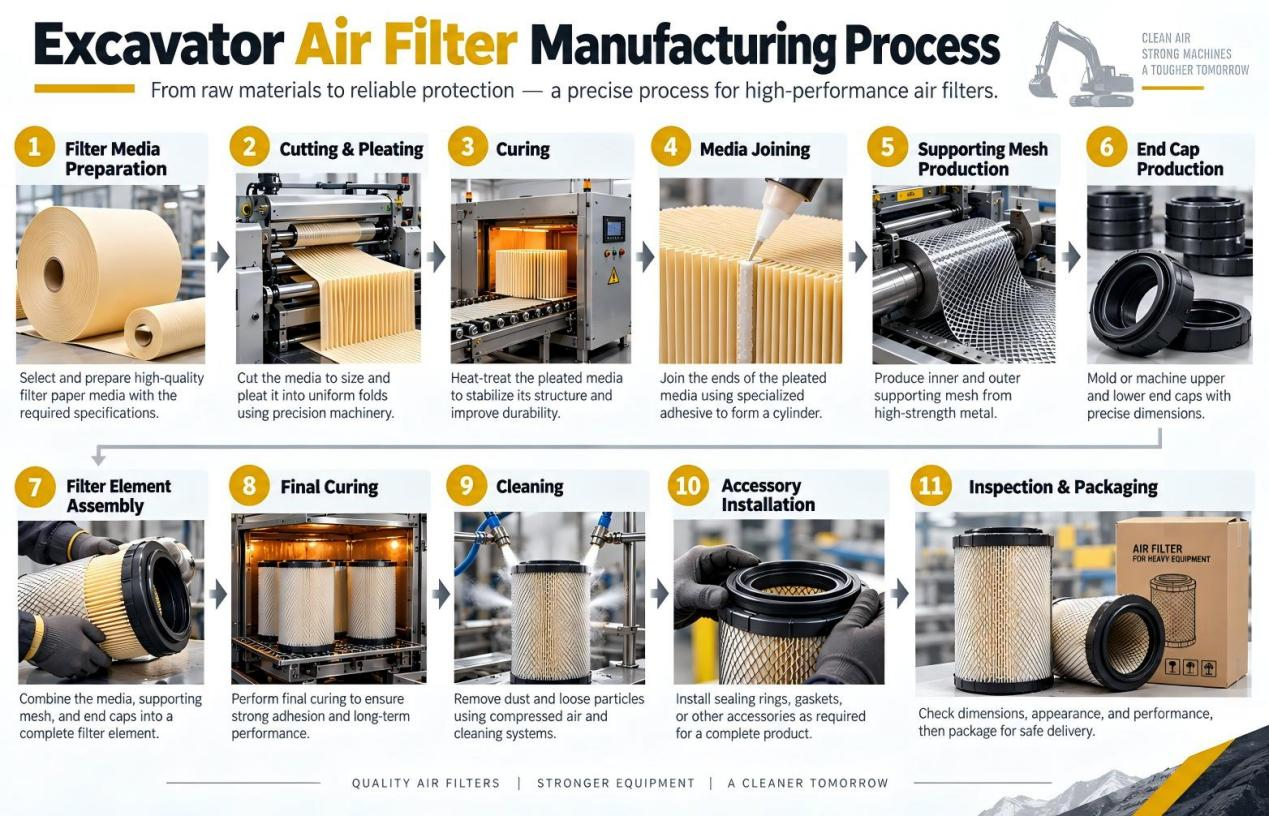
A simplified production flow can be described as:
Filter Media Preparation → Pleating → Curing → Media Joining → Supporting Mesh Production → End Cap Production → Filter Element Assembly → Curing → Cleaning → Accessory Installation → Inspection → Packaging
Each stage prepares the filter for the next operation and helps maintain consistent construction.
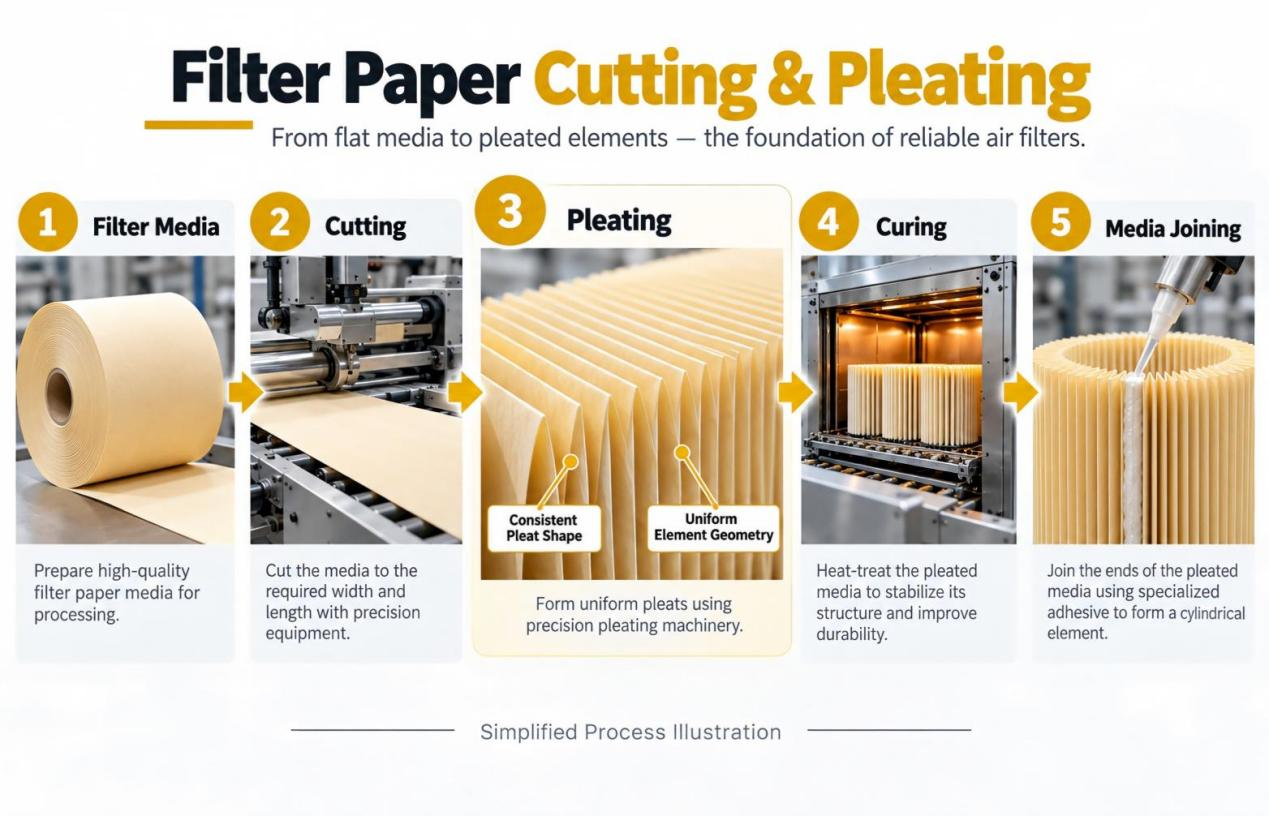
The manufacturing process begins with filter media.
The material is prepared according to the required filter element size, then cut and formed into repeated pleats.
The production document identifies:
Filter Paper → Cutting / Pleating
Pleating gives the filter element its characteristic folded structure. Consistent pleat shape and spacing help maintain the geometry of the finished element and make later assembly more controlled.
Uneven pleats may lead to irregular element shape or positioning during assembly.
After pleating, the filter media goes through a curing stage.
The document specifically includes low-temperature curing in the air-filter paper process.
This stage helps stabilize the formed media before it moves into joining and assembly.
The two ends of the pleated media are then joined to create a cylindrical filter element.
The production process also includes securing the element after joining.
During this stage, the element can be checked for:
Joint alignment
Overall shape
Visible gaps
Deformation
A properly formed media element is important for the following assembly steps.
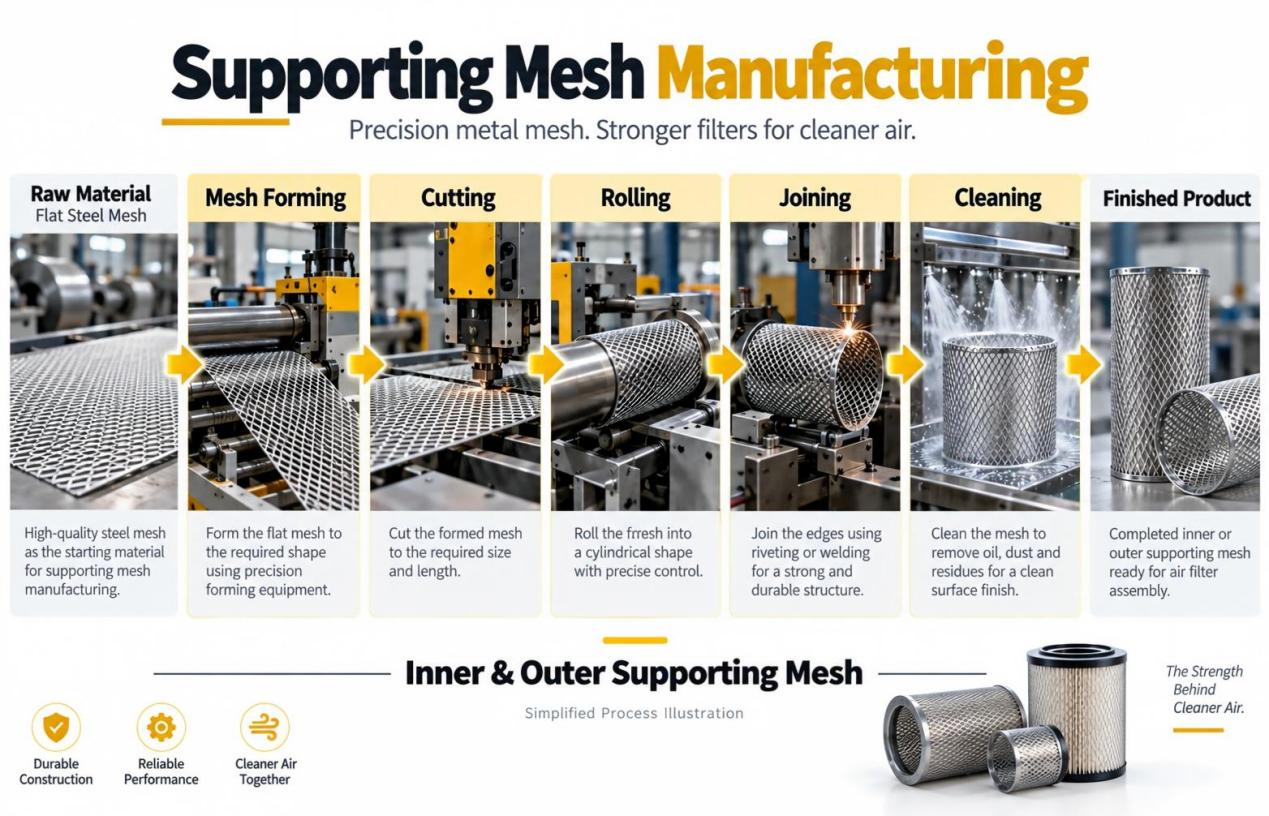
The inner and outer supporting mesh are produced separately.
According to the document, the process includes:
Mesh Forming → Cutting → Rolling → Riveting or Welding → Cleaning
The mesh is formed and cut to size, rolled into a cylindrical shape and connected by riveting or welding. Afterward, it is cleaned before entering the final filter assembly process.
The supporting mesh helps protect the filter media and maintain the structure of the finished heavy equipment air filter.
The upper and lower end caps are another important part of the filter.
The document shows that the end-cap process includes material preparation, press forming and cleaning. It also includes sealing and bonding-related operations before final assembly.
The end caps must be correctly formed so they can align with the filter media and supporting structure during assembly.
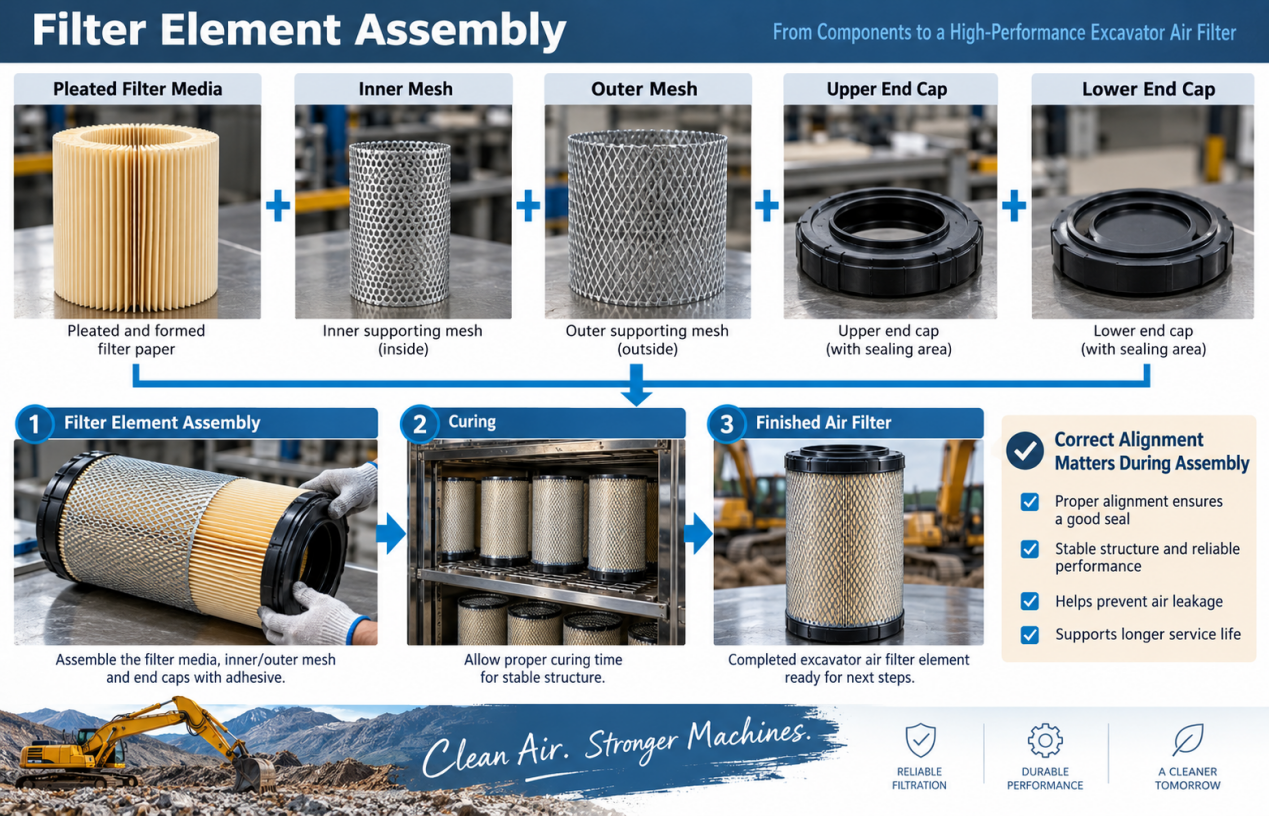
Once the media, mesh and end caps are prepared, the separate components are assembled into a complete filter element.
During this stage:
The pleated media is positioned inside the supporting structure
The inner and outer mesh are aligned
The upper and lower end caps are installed
Bonding material is applied where required
Correct positioning is important because a filter can look normal externally while still having differences in internal construction.
After assembly, the filter element goes through another curing stage.
The production document lists:
Filter Element Assembly → Curing
This allows the assembled components and bonding areas to stabilize before cleaning and final handling.
After curing, the finished air filter is cleaned.
This helps remove visible manufacturing residue and prepares the product for the next stage.
The document then identifies accessory installation before inspection and packaging.
The exact accessories may vary depending on the filter design.
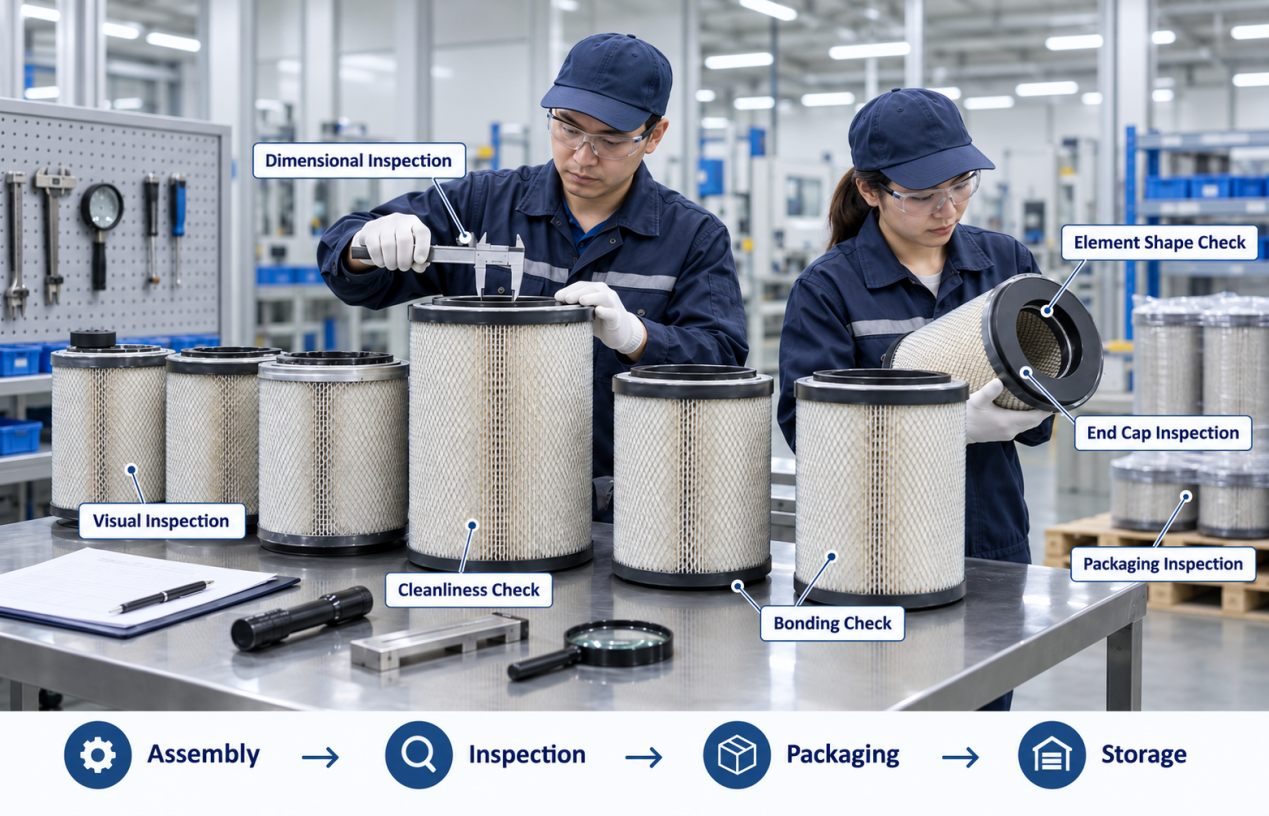
The final stages are inspection, packaging and storage.
The production flow ends with:
Packaging / Inspection → Finished Product Storage
Before packaging, typical checks may include:
Overall appearance
Visible deformation
Filter element shape
End-cap bonding condition
Cleanliness
Assembly condition
Dimensional consistency
For B2B buyers, final inspection is important because it helps identify avoidable problems before products enter distribution or export channels.
Several stages deserve particular attention when evaluating an excavator air filter.
Filter media forming affects the overall element structure.
Pleat consistency helps maintain uniform geometry.
Supporting mesh production contributes to structural support.
End-cap assembly affects how the filter element is secured.
Bonding and curing help stabilize the assembled structure.
Final inspection provides a final check before packaging.
This is why air filters should not be evaluated only by external appearance.
Distributors and importers should confirm more than the product photo.
Useful information includes:
Part number
Excavator model
Engine model
Overall dimensions
Filter element design
Sealing structure
Cross-reference information
Required quantity
Packaging requirements
If the original part number is available, it should normally be used as the starting point for compatibility confirmation.
Similar size does not always mean identical compatibility.
The air filter manufacturing process involves much more than placing filter paper inside a housing.
From media cutting and pleating to supporting mesh production, end-cap forming, filter assembly, curing, cleaning and final inspection, each stage contributes to the construction of the finished excavator air filter.
For distributors, importers and construction equipment parts buyers, understanding these manufacturing steps can make it easier to compare products based on structure and production consistency rather than price or appearance alone.
When sourcing replacement excavator air filters, providing the part number, machine model, engine model and required quantity can help suppliers confirm the appropriate filter specification more accurately.


