
- All
- Product Name
- Product Keyword
- Product Model
- Product Summary
- Product Description
- Multi Field Search

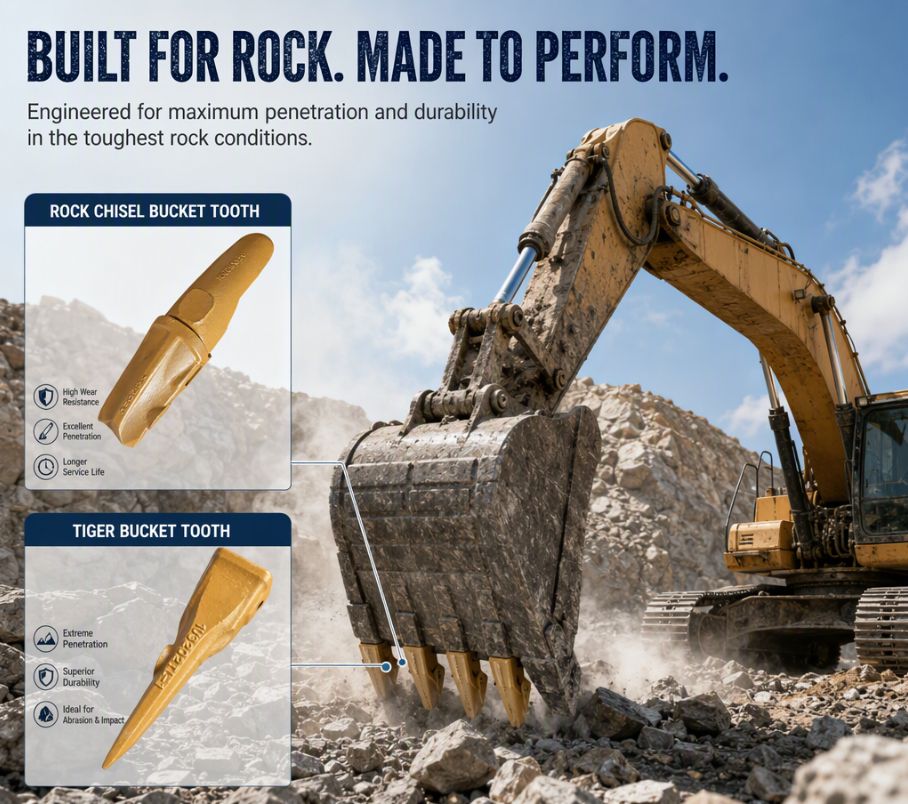
Choosing between a rock chisel bucket tooth and a tiger bucket tooth depends mainly on the ground conditions and the balance you need between penetration, strength, and wear resistance. A tiger bucket tooth is generally designed for aggressive penetration, while a rock chisel bucket tooth is better suited to hard and rocky ground where penetration must be combined with durability and impact resistance.
The difference comes from their working profiles. A tiger bucket tooth uses a narrower, sharper point to concentrate digging force and penetrate compacted material efficiently. A rock chisel tooth uses a more robust profile designed to maintain penetration while providing greater support in demanding rock excavation. This makes tooth selection more than a matter of choosing the sharpest or strongest option—it is about matching the tooth geometry to the material, excavator, bucket, and operating conditions.
For contractors, equipment distributors, and GET buyers, the most reliable selection starts with three factors: what material the excavator is digging, how the existing teeth are wearing, and which tooth-and-adapter system the bucket uses. These factors provide a more practical basis for selecting the right replacement tooth than excavator size or unit price alone.
Feature | Rock Chisel Bucket Tooth | Tiger Bucket Tooth |
Primary design objective | Balance penetration, strength, and rock performance | Maximize penetration |
Profile | Pointed/chisel-style with a stronger working profile | Narrow, sharp, pointed profile |
Penetration | High | Very high |
Impact resistance | Generally suited to higher-impact work | Strong penetration but profile selection must match impact conditions |
Typical materials | Rock, hard ground, compacted material | Hardpan, compacted soil, frost, rock and difficult ground |
Wear behavior | Designed to balance penetration and wear | Sharp profile can prioritize penetration over wear mass |
Typical applications | Quarrying, rock excavation, hard ground, bucket rebuilding | Trenching, compacted ground, frozen ground, aggressive excavation |
Main selection priority | Penetration + durability | Penetration |
Industry references similarly distinguish rock chisel profiles from tiger profiles by their balance between penetration and wear versus maximum penetration. YASSIAN, for example, describes its rock chisel bucket teeth as a rock-oriented design with good penetration and a balance between penetration and wear, while its tiger bucket teeth is designed for maximum penetration.
A rock chisel bucket tooth is a practical choice when the bucket regularly encounters hard or rocky material and the tooth must withstand both penetration and impact.
Typical applications include:
Rock excavation
Quarrying
Hard and compacted ground
Fractured rock
Heavy construction excavation
For these applications, a tooth with sufficient material around the working area can provide a useful balance between penetration and wear resistance.
YASSIAN supplies rock chisel teeth for multiple GET systems. For example, the XS50RC Rock Chisel Tooth is designed for the Hensley XS50 system, while the 713-00032RC Rock Chisel Bucket Tooth is available for selected Doosan/Daewoo and Solar/DX applications.
A tiger bucket tooth emphasizes penetration. Its narrow working point concentrates digging force into a smaller contact area, helping the bucket break into compacted or difficult material.
Tiger teeth are commonly considered for:
Compacted soil
Hardpan
Frozen ground
Clay
Trenching
Aggressive excavation
They can also be used in certain rock applications, but the specific tooth design should be matched to the level of impact and abrasion involved.
The key question is therefore not whether a tiger bucket tooth can enter hard material, but whether its penetration-focused profile provides sufficient durability for the actual working conditions.

1U3252TL J250 Single Tiger Bucket Tooth
For sustained rock excavation, a rock chisel bucket tooth is generally the more application-specific option, particularly when impact and tooth durability are important alongside penetration.
However, rock conditions vary considerably. Fractured rock, abrasive rock, compacted soil with rocks, and solid rock can produce very different wear patterns.
Working Condition | Recommended Direction |
Compacted soil | Tiger bucket tooth |
Hard clay | Tiger or rock chisel |
Hardpan | Tiger bucket tooth |
Fractured rock | Rock chisel |
Quarrying | Rock chisel |
High-impact rock | Rock-oriented tooth |
Mixed hard ground | Select according to wear and impact |
For B2B buyers, tooth performance should not be judged by penetration alone.
A very narrow tooth may penetrate efficiently but can lose its working point quickly in abrasive material. A heavier rock-oriented tooth may provide greater wear capacity but can require more breakout force.
The objective is to find the best balance for the application:
Ground conditions → Tooth profile → Penetration → Wear rate → Productivity
Actual service life also depends on material quality, heat treatment, excavator size, bucket capacity, operator technique, and adapter condition. Therefore, there is no universal service-life figure that applies to every rock chisel or tiger bucket tooth.
A replacement bucket tooth must match the adapter and retention system, not just the excavator model.
Before purchasing, verify:
Existing tooth part number
Adapter part number
Tooth system
Pin and retainer type
Tooth dimensions
Bucket configuration
Excavator model and serial number
For example, YASSIAN's XS50RC tooth is paired with a compatible 1060MXS50 centre weld-on adapter for the Hensley XS50 system. This illustrates why tooth and adapter compatibility should be checked as a complete system.
For aftermarket replacement parts, providing photos, dimensions, or the original part number can also help confirm fitment.
For distributors, contractors, and equipment parts buyers, the purchase decision should go beyond unit price.
Factor | What to Check |
Profile | Rock chisel, tiger, general purpose, etc. |
Material | Steel grade and material consistency |
Heat treatment | Hardness and toughness |
Compatibility | Tooth, adapter and retainer system |
Wear performance | Expected behavior in the target material |
Quality control | Dimensional and production consistency |
Supply | MOQ, lead time and replacement availability |
A lower-priced tooth may not provide lower operating costs if it wears quickly, causes downtime, or does not fit the existing adapter correctly.
The choice between a rock chisel bucket tooth and a tiger bucket tooth should be based on application rather than a simple "which is better" comparison.
Choose a tiger-style profile when penetration is the primary requirement, particularly in compacted soil, hardpan, frozen ground, or other materials where a narrow working point can improve digging performance. Consider a rock chisel bucket tooth when the application involves hard or rocky ground, repeated impact, and a need to balance penetration with tooth durability.
Before ordering replacement teeth, also verify the tooth system, adapter, pin and retainer, bucket configuration, and machine application. A tooth that looks similar may not be interchangeable with the existing system.
YASSIAN supplies rock chisel bucket teeth, tiger teeth, adapters, pins, retainers, and other ground engaging tools for a range of excavator applications. If you are sourcing replacement bucket teeth for construction, quarrying, mining, or equipment distribution, provide the existing tooth part number, machine model, or tooth and adapter dimensions to help identify the appropriate solution.
Need help selecting the right excavator bucket tooth? Contact YASSIAN with your existing tooth or adapter information for product and fitment recommendations.


