
- All
- Product Name
- Product Keyword
- Product Model
- Product Summary
- Product Description
- Multi Field Search
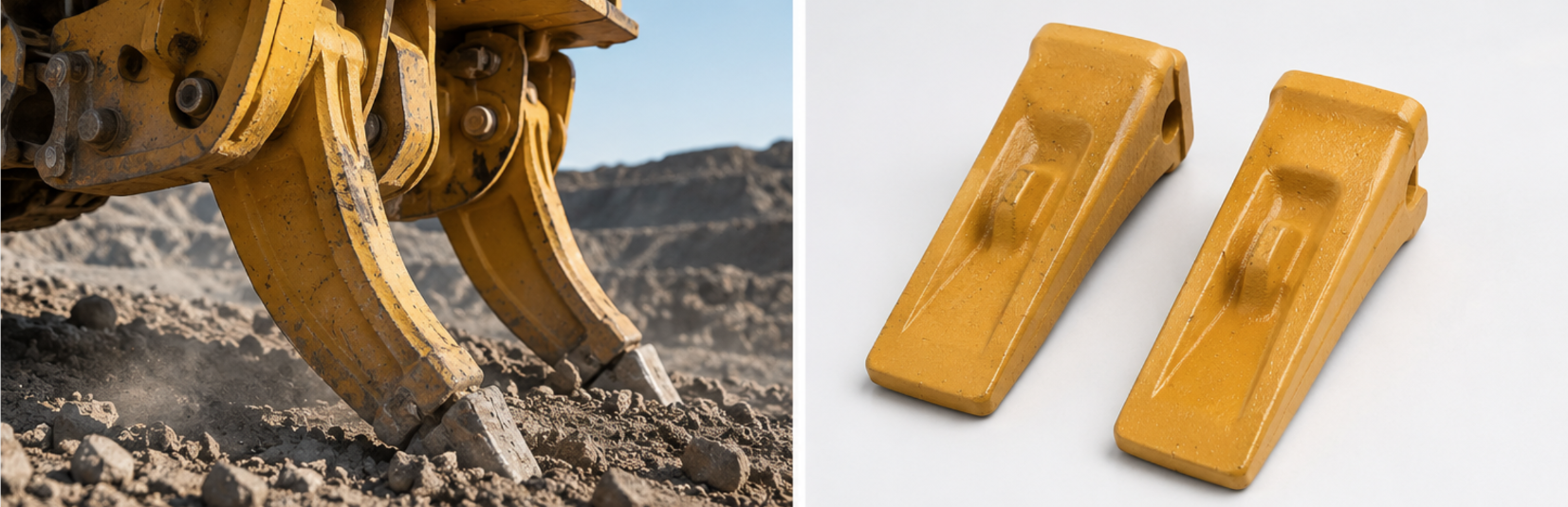
Among heavy-duty dozer ripper teeth, centerline and non-centerline ripper teeth are two common configurations. Although they may look similar at first glance, their geometry, position on the ripper shank, machine compatibility, and intended application can differ.
For equipment dealers, contractors, mining companies, and GET distributors, understanding the difference is important when selecting a replacement tooth. Choosing the wrong configuration can result in poor fitment, reduced penetration, accelerated wear, or unnecessary downtime.
This guide explains the difference between non-centerline ripper teeth and centerline ripper teeth, how to identify them, when each type is used, and what buyers should check before ordering replacement ripper teeth.
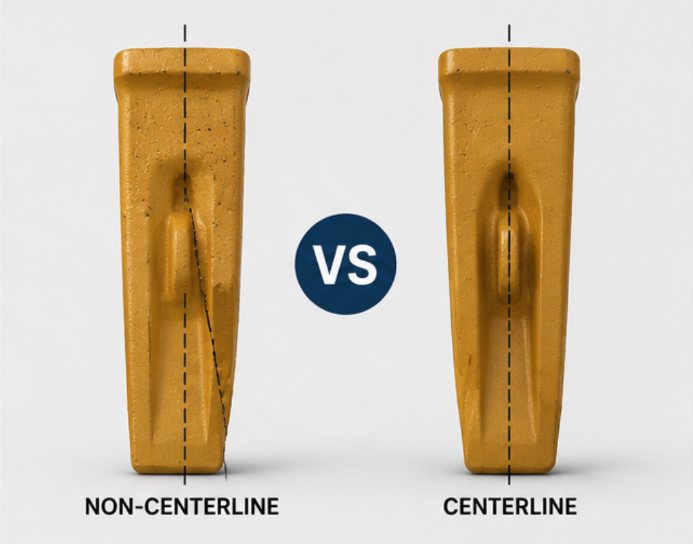
The primary difference is the position and geometry of the tooth relative to the ripper shank and its working centerline.
A centerline ripper tooth is designed around the centerline of the ripper shank, while a non-centerline ripper tooth is offset from that centerline. This difference in geometry affects how the tooth engages the ground and, more importantly for replacement buyers, determines whether the tooth is compatible with a particular shank and machine configuration.
In other words, centerline and non-centerline teeth should not be treated as interchangeable simply because they belong to the same ripper series.
The correct choice depends on the machine model, ripper shank, tooth series, part number, dimensions, and application.
Centerline vs. Non-Centerline Ripper Tooth at a Glance
Feature | Centerline Ripper Tooth | Non-Centerline Ripper Tooth |
Tooth position | Aligned with the shank centerline | Offset from the shank centerline |
Main consideration | Centered tooth/shank geometry | Offset tooth/shank geometry |
Fitment | Requires matching centerline configuration | Requires matching non-centerline configuration |
Replacement method | Match tooth series, shank and part number | Match tooth series, shank and part number |
Application | Depends on machine and shank design | Depends on machine and shank design |
Identification | Part number + geometry + dimensions | Part number + geometry + dimensions |
Suitable for aftermarket replacement | Yes, when correctly matched | Yes, when correctly matched |
The tooth configuration must match the ripper system rather than being selected by appearance alone.
A non-centerline ripper tooth is a ripper tooth designed with an offset configuration relative to the centerline of the ripper shank.
This design is used on specific dozer ripper systems and is identified by its corresponding tooth geometry, shank interface, and part number.
A centerline ripper tooth is designed so that its working geometry is aligned with the centerline of the associated ripper shank.
Centerline teeth are also available in multiple sizes and machine configurations. Therefore, "centerline" alone is not enough information to identify a replacement.
For example, industry replacement catalogs distinguish between centerline and non-centerline configurations within the same general ripper families. For Komatsu applications, published reference data lists both centerline and non-centerline teeth for different machine families, including the D375 and D475.
This means that a buyer should avoid selecting a replacement simply because:
the tooth looks similar;
the overall length appears close;
the tooth belongs to the same machine brand; or
the tooth is advertised for the same general ripper series.
The shank interface and tooth configuration must be verified.
A ripper tooth transfers significant force from the machine into the ground. Its centerline position and geometry affect penetration, ground-breaking efficiency, tooth and shank wear, and overall machine productivity.
If the tooth configuration does not match the ripper shank, it may fit poorly, wear unevenly, reduce performance, or increase operating costs. Therefore, centerline and non-centerline configurations are important factors when selecting replacement GET parts.
Not necessarily.
It is incorrect to assume that a non-centerline ripper tooth is automatically stronger, more productive, or better than a centerline tooth—or vice versa.
The better choice is the configuration designed for the specific ripper shank and working application.
A correctly matched tooth should provide the appropriate combination of:
fitment
penetration
wear resistance
structural strength
ground engagement
retention compatibility
service life
For example, a heavy-duty non-centerline tooth may be an excellent replacement for the correct Komatsu D475 ripper application, but that does not mean it can replace a centerline tooth designed for the same general machine family.
The difference becomes clearer when looking at actual part numbers.
YASSIAN lists 195-78-71320 as a non-centerline ripper tooth for the Komatsu D375 dozer and 198-78-21340 as a non-centerline ripper tooth for the Komatsu D475 dozer.
Independent replacement-part reference data also identifies these two part numbers as non-centerline configurations and distinguishes them from centerline teeth used on the same or related machine families.
This demonstrates why a professional replacement process should start with the machine and existing tooth identification, not simply with the word "ripper tooth."
Machine | Example Part Number | Configuration |
Komatsu D375 | 195-78-71320 | Non-Centerline |
Komatsu D475 | 198-78-21340 | Non-Centerline |
Komatsu D375 | 195-78-71350 | Centerline |
Komatsu D475 | 198-78-21370 | Centerline |
Even within the same machine family, centerline and non-centerline configurations can have different part numbers and geometries.
Always verify the actual machine configuration and replacement requirements before ordering.
If you need to replace a worn tooth, use the following identification process.
Start with the dozer model.
Examples include:
Komatsu D375
Komatsu D475
Caterpillar D8
Caterpillar D9
Caterpillar D10
Caterpillar D11
The machine model narrows down the possible ripper systems, but it does not by itself confirm the tooth.
The part number is usually the fastest way to identify a replacement.
For example: 198-78-21340 is identified as a non-centerline ripper tooth for the Komatsu D475 in YASSIAN's product range.
If the original part number is available, provide it to the supplier when requesting a quotation.
The tooth must work with the correct shank and retention system.
Check:
shank profile
tooth pocket
pin or retainer
tooth orientation
mounting dimensions
overall geometry
If the part number is unavailable, measurements become especially important.
Depending on the tooth system, relevant dimensions can include:
overall length
tooth width
tooth height
pocket dimensions
mounting dimensions
pin diameter
retainer dimensions
tooth angle
This is the step that is frequently overlooked.
Two teeth can have similar dimensions while using different configurations.
Therefore, tell your supplier explicitly whether you need a:
Centerline ripper tooth or Non-centerline ripper tooth.
The difference between a non-centerline ripper tooth and a centerline ripper tooth is primarily related to their geometry and position relative to the ripper shank centerline. Although both are designed to perform demanding ground-engaging work, they are not simply interchangeable versions of the same component.
For equipment owners and GET distributors, the safest approach is to identify the machine model, ripper shank, tooth configuration, part number and dimensions before ordering.
As a professional aftermarket ground engaging tools manufacturer, YASSIAN provides ripper teeth and other GET wear parts for construction and mining equipment, with a focus on wear resistance, dimensional consistency and aftermarket supply for distributors and equipment users.
Need to identify a replacement non-centerline ripper tooth? Send us your machine model, existing part number or tooth photos and dimensions. Our GET team can help confirm the appropriate replacement configuration.


