
- All
- Product Name
- Product Keyword
- Product Model
- Product Summary
- Product Description
- Multi Field Search

Choosing the right track link is essential for reliable excavator or bulldozer undercarriage performance. Although two track links may look similar, differences in pitch, dimensions, link count, pin and bushing size, or machine configuration can cause poor fitment and accelerated wear.
For distributors, importers, contractors, and equipment owners, selecting the correct excavator track link or bulldozer track link requires more than matching the machine model. The complete undercarriage system should also be considered.

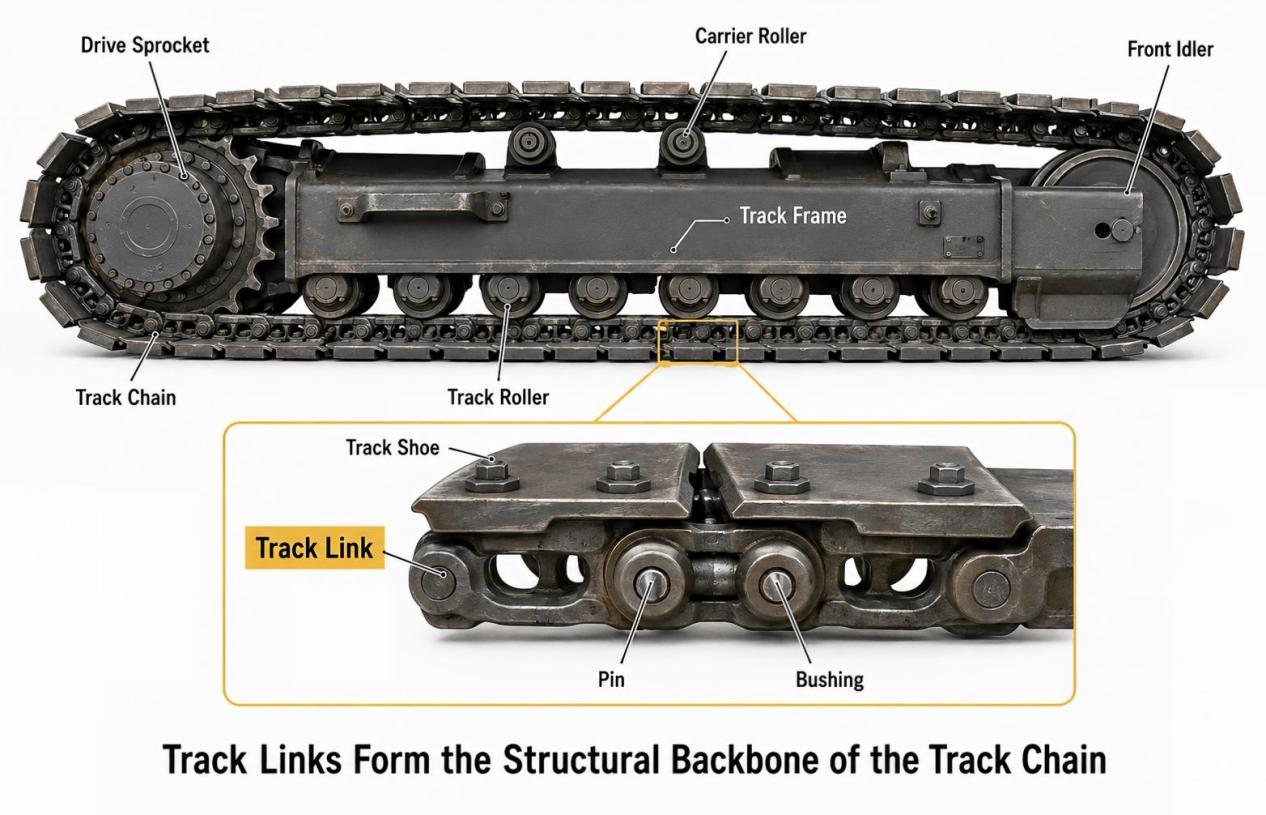
A track link is one of the main structural parts of a crawler undercarriage. Multiple links are connected by pins and bushings to form the track chain assembly.
A typical track chain includes:
Track links
Pins
Bushings
Track shoes
Master link or master pin
Bolts and nuts
The track chain works with the sprocket, idler, rollers, and track shoes to support machine movement and transfer travel force.
Start by identifying:
Machine brand
Machine model
Serial number
Existing part number
Machine model alone may not always be enough. The same model can use different undercarriage configurations depending on serial number, production year, or track shoe specification.
Providing complete machine information helps the supplier confirm compatibility more accurately.
An OEM or reference number is often the fastest way to identify the correct track link.
Useful information includes:
OEM part number
Track chain assembly number
Previous supplier number
Identification marks on the old part
If the number is unavailable, send clear product photos and measurements.
Never choose a replacement track link only by appearance.
Track link pitch is one of the most important specifications.
Track pitch generally refers to the center-to-center distance between adjacent track pins.
Correct pitch is essential because the track chain must engage properly with the drive sprocket.
Incorrect pitch can cause:
Poor sprocket engagement
Abnormal vibration
Track jumping
Increased bushing wear
Faster sprocket wear
Reduced service life
Always confirm the track chain pitch before ordering.
When the part number is uncertain, measure the existing component carefully.
Important dimensions may include:
Track pitch
Link height
Link width
Rail height
Rail width
Pin diameter
Bushing diameter
Bushing length
Bolt hole size and spacing
Small differences can affect installation and performance.
The number of links in a complete track chain also matters.
Two chains may use the same pitch but have different link counts, resulting in different total lengths.
For a complete track chain assembly, confirm:
Machine Model + Track Pitch + Link Count + Part Number
This combination helps reduce ordering mistakes.
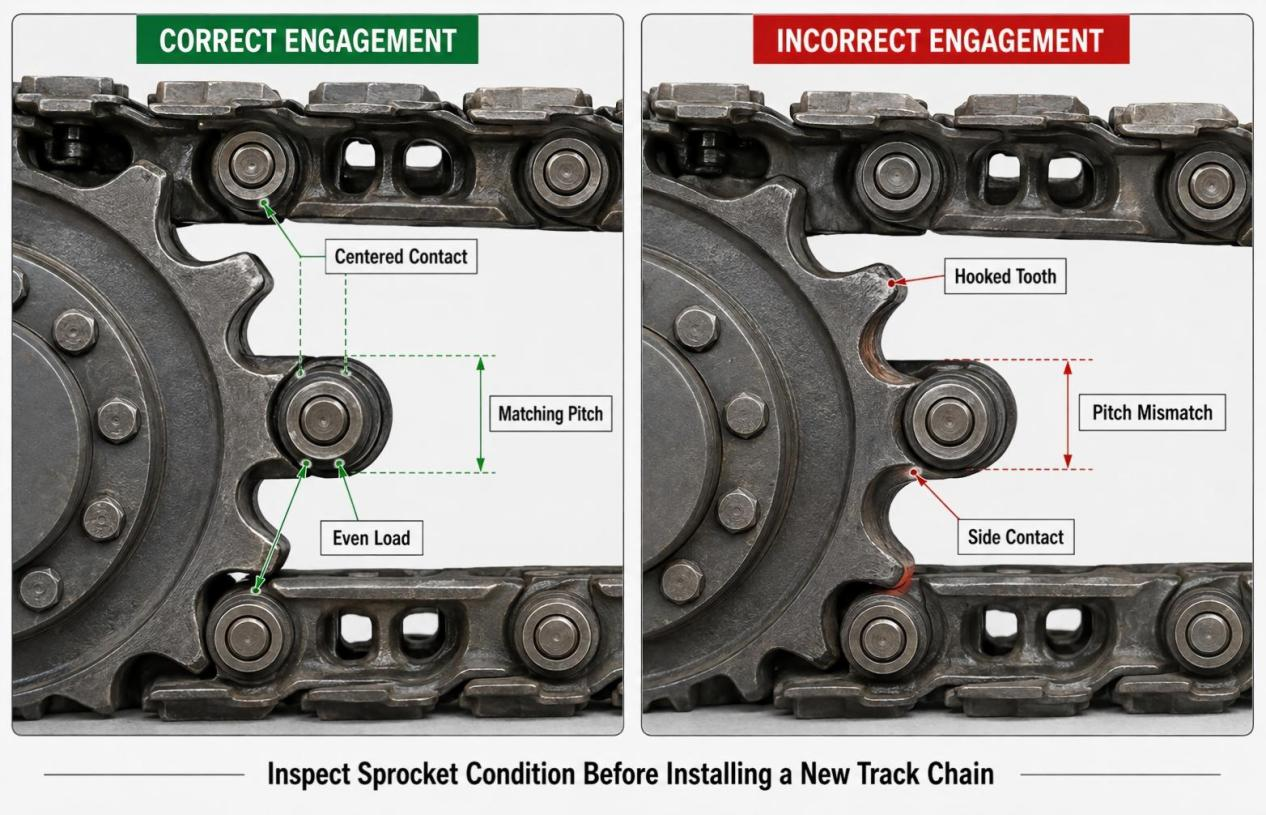
The sprocket and track chain work together continuously.
Correct engagement should provide:
Centered contact
Smooth movement
Even load distribution
Stable tooth-to-bushing engagement
If the sprocket teeth are sharp, hooked, or unevenly worn, installing a new track chain may quickly damage the new bushings.
Always inspect the sprocket before replacing the track link assembly.
Pins and bushings are critical to track chain service life.
Common wear includes:
External bushing wear
Internal pin wear
Pitch elongation
Loose joints
Uneven articulation
As pins and bushings wear, the effective chain pitch may increase, leading to poor sprocket engagement.
For heavy-duty applications, buyers should consider material quality, heat treatment, dimensional accuracy, and assembly quality.
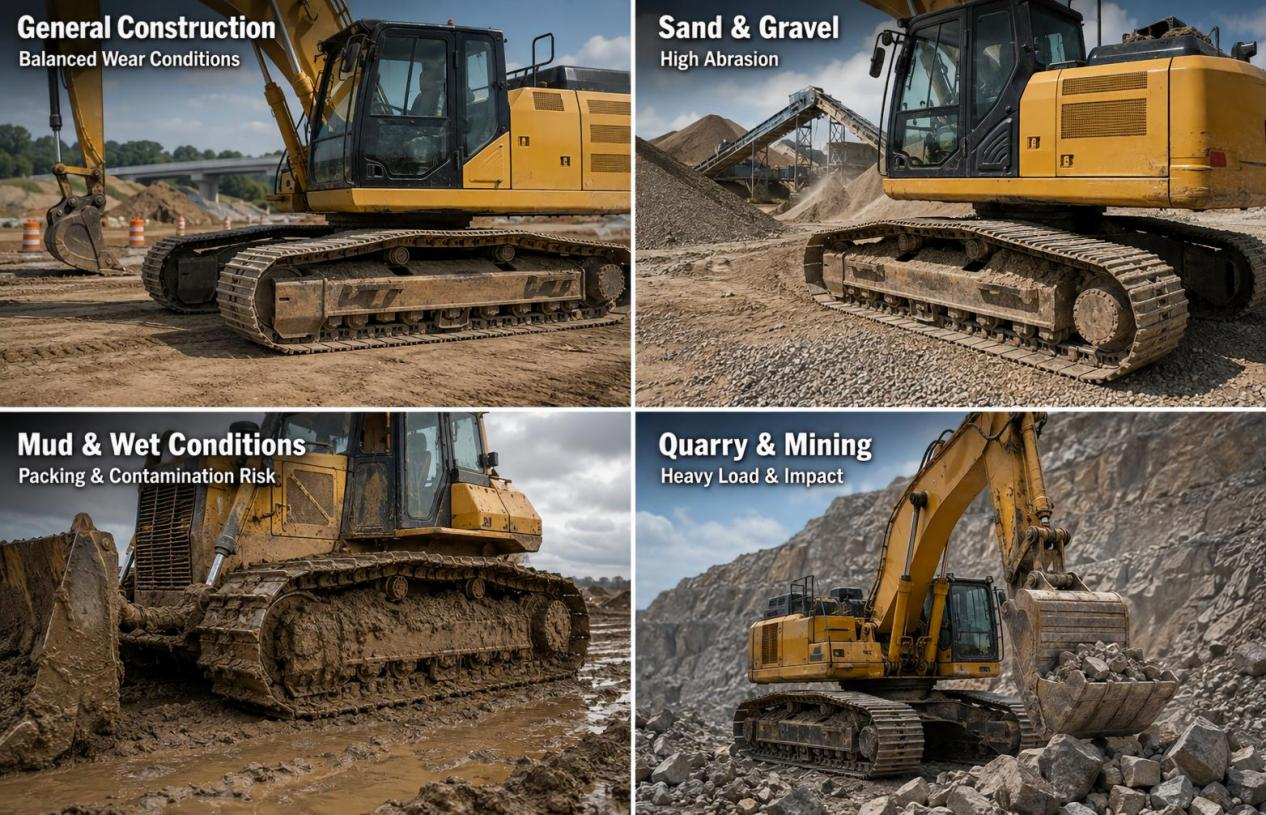
The correct track link also depends on operating conditions.
Requires balanced toughness and wear resistance.
High abrasion can accelerate rail, pin, and bushing wear.
Mud packing and contamination can increase joint wear.
Heavy loads, impact, abrasive material, and long working hours place greater stress on the undercarriage.
For severe applications, pay more attention to steel quality, heat treatment, rail wear resistance, and pin-and-bushing durability.
Price should not be the only factor when choosing an excavator track link.
A good track link should balance:
Strength
Toughness
Hardness
Wear resistance
Proper heat treatment should create a wear-resistant surface while maintaining enough core toughness to withstand impact.
When comparing suppliers, ask about manufacturing processes, batch consistency, and inspection procedures instead of relying only on advertised hardness values.
Typical inspections may include:
Dimensional inspection
Pitch inspection
Link profile inspection
Pin and bushing inspection
Surface hardness test
Crack inspection
Assembly inspection
Visual inspection
Packaging inspection
A common production process is:
Forging or Casting → Machining → Heat Treatment → Assembly → Inspection → Packaging
For distributors and importers, stable batch quality is especially important.
Before installing a new track chain assembly, inspect:
Drive sprocket
Front idler
Track rollers
Carrier rollers
Track shoes
Track tension
A new chain running on heavily worn components may develop abnormal contact and premature wear.
The undercarriage should be treated as one complete system.
Prepare the following:
Machine brand and model
Serial number if available
OEM or reference number
Track pitch
Link count
Product photos
Critical dimensions
Required quantity
Working conditions
The more accurate the information, the easier it is to confirm the correct track link.
Avoid:
Choosing by appearance only
Checking only the machine model
Ignoring track pitch
Forgetting link count
Installing a new chain on worn sprockets
Comparing suppliers only by price
A better purchasing decision considers fitment, material, heat treatment, machining accuracy, pins and bushings, and quality control.
Choosing the right track link requires checking the machine model, part number, track pitch, link count, critical dimensions, pin and bushing specifications, sprocket compatibility, and working conditions.
If you are sourcing replacement excavator track links, bulldozer track links, or complete track chain assemblies, provide your supplier with accurate machine and product information. This helps reduce ordering errors, improve compatibility, and support longer undercarriage service life.


